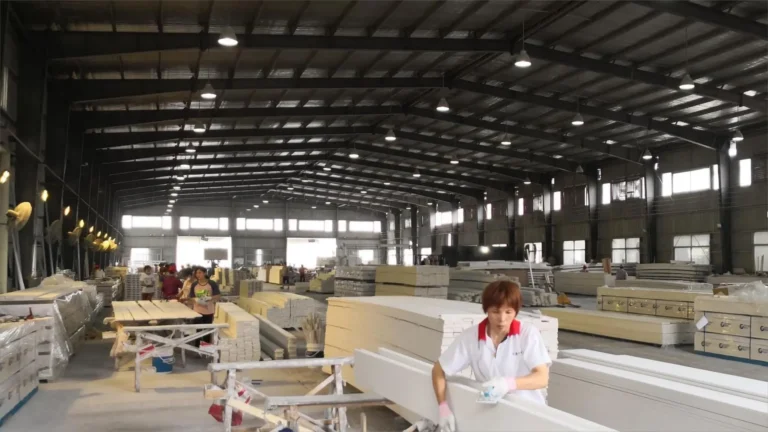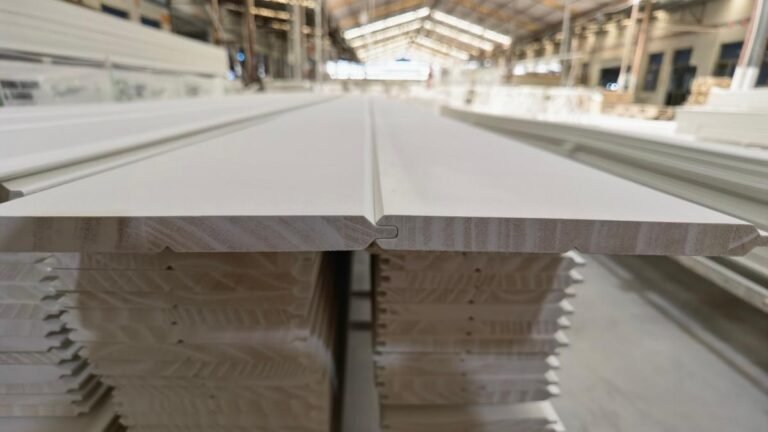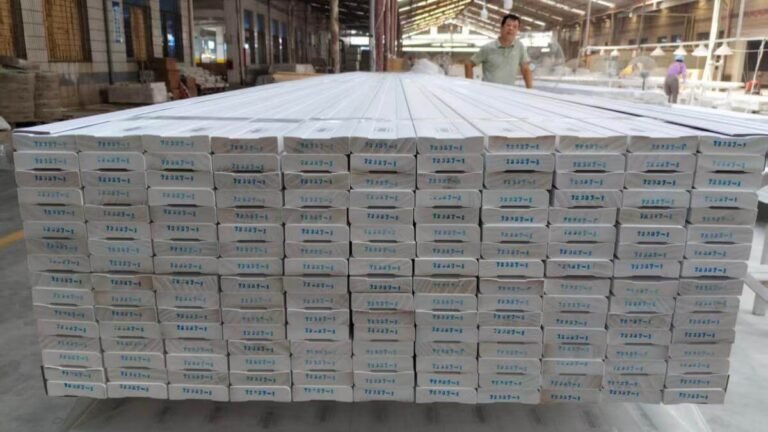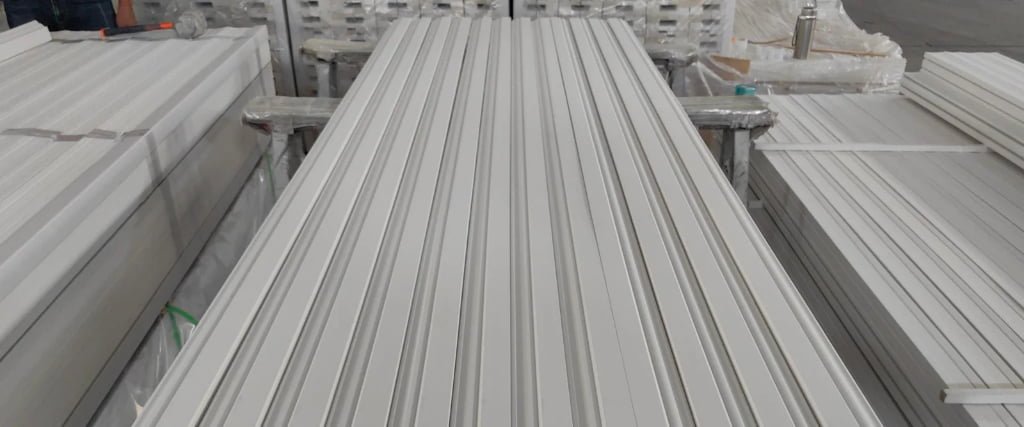
Many of the moulding (also spelled molding in the US) problems we have traced were not caused by poor machining. They came from a good product used in the wrong job or the wrong climate. Founded in 1995, we make all four types on a 200,000 m² site in Xiamen, with log processing, finger-jointing, veneering, coating and CNC finishing all done in-house. Because we make every type, we have no reason to push you toward one, and we have seen how each one fails when it is misused.
This guide gives you the decision rules we use ourselves: finish, climate, installation location, budget and order size. It also says plainly where each type should not be used.
What is the real difference between solid wood, finger-jointed, MDF and veneered moulding?
The four types differ in what they are made from. Solid wood is milled from a single piece of timber. Finger-jointed moulding is made from short timber sections glued end to end. MDF moulding is milled from engineered fibreboard. Veneered moulding is a thin veneer bonded onto an MDF or timber core. The base material decides stability, finish and cost.
| Solid wood | Finger-jointed | MDF | Veneered | |
|---|---|---|---|---|
| Made from | One piece of timber | Short timber sections, finger-jointed | Medium-density fibreboard | Veneer over MDF or timber core |
| Best finish | Paint or clear coat | Paint only | Paint (very smooth surface) | Clear coat or paint, depending on veneer |
| Moisture behaviour | Moves with humidity | More stable than long solid sections | Stable in dry rooms, weak when wet | Depends on the core |
| Relative cost | Highest | Mid | Lowest | Mid to high |
| Biggest limit | Movement and knots | Joints show under clear finishes | Indoor dry areas only | Veneer grain and thickness limits |
None of these is "the best" in general. Each is the right answer to a different question. You can see each range in detail on our pages for solid wood, finger-jointed, MDF and veneered moulding.
Which type suits paint-grade work, and which suits stain-grade?
For paint-grade work, finger-jointed and MDF are usually the practical choices, and solid wood is an option at a higher price. For stain-grade or clear-coat work, choose solid wood or veneered moulding. Finger-jointed moulding is not suitable for stain-grade applications. This is the first decision to make, because it removes options immediately.
The reason is structural. Finger joints stay visible under transparent or semi-transparent finishes, however precise the machining. This is a limit of the construction, and any supplier's finger-jointed moulding has it. We tell every buyer this before quoting. It is not a defect we can polish away.
| Your application | Suggested type | Why |
|---|---|---|
| Painted baseboards and casings, budget-sensitive | Finger-jointed | Paint hides the joints; good use of timber |
| Painted profiles with fine detail or a very smooth finish | MDF (higher density) | Sharp milled edges, even paint uptake |
| Painted, large batches needing the most uniform colour | MDF | No grain variation between pieces |
| Clear-coat or stained, premium look | Solid wood (J2 grade) or veneered | Continuous grain, no visible joints |
| Clear-coat with tight consistency across a project | Veneered (engineered veneer) | More uniform than natural timber |
| Door frames carrying a door's weight | Finger-jointed with PUR adhesive (our standard for door frame SKUs) | Joint strength matters; tell us the door weight (see below) |
One caution on solid wood for stain-grade work. Even J2 grade, the highest appearance class under EN 9421, can contain small live knots. If you need a completely uniform visible face, use a Select and Better grade or a veneered product instead.

How do climate and destination market change the choice?
Destination climate can decide the material as much as the finish does. A moulding that is fine in Sydney's coastal humidity can distort in a heated North American winter, and the reverse is also true. Choose the type and the shipping moisture content for the place the product will be installed, not the place it was made.
Xiamen is subtropical, with average relative humidity around 75–80% and more than 90% in the plum-rain season. Timber made there has to be dried for a very different indoor environment on the other side of the world. We cover our two largest export destinations on the United States and Australia market pages.
| Destination | Typical indoor conditions | Our shipping moisture content | What we watch for |
|---|---|---|---|
| North America | Heated winters, indoor RH often 20–35% | 8–10% | Shrinkage, cupping on wide solid wood |
| Europe | Maritime climate, indoor RH 40–60% | 10–12% | Moderate humidity; holding moisture within target |
| Australia (southern and coastal) | Humid coast | 10–12% | End-face moisture uptake on MDF |
| Australia (hot, humid regions such as Queensland) | Hot and humid | 12–14% | Avoid over-drying |
Passing a moisture check at the kiln is not the same as being ready to ship. Timber dries from the outside in, so in thick solid stock the core can still read 3–5% higher than the surface. Cutting before the material has rested for one to two weeks releases stress and causes bowing. For the full explanation, read Moisture Content Passed Inspection — So Why Did It Still Warp?
Width matters as well. Solid wood profiles 90 mm wide or more can change size by 0.5–2.0 mm in a heated North American winter, depending on species, starting moisture and site conditions. For solid wood at 90 mm or wider, we cut back-relief grooves into the reverse face on North American orders. This is our standard factory practice, not an industry requirement. For very wide profiles in dry-climate markets, finger-jointed or MDF is often the more stable choice.
How does each type actually fail, and what do we do about it?
Each type has a signature failure: wide solid wood cups, finger joints telegraph through paint, MDF ends swell when wet, and thin veneer sands through on tight curves. In each case we changed our factory procedure once the cause was traced, and those changes are now our standard process.
| Type | Typical failure | Root cause | What we do now |
|---|---|---|---|
| Solid wood (wide) | Cupping 2–3 months after installation | Moisture content too high for a heated interior; unbalanced shrinkage | Back-relief grooves on wide profiles for North America; lower shipping moisture target |
| Finger-jointed | Joints "telegraph" through paint after 6–18 months | Joint area absorbs paint differently from surrounding timber | Thicker UV primer, second sanding of joints, extra primer coat |
| Finger-jointed (door frames) | Joint creep under repeated door movement | Adhesive not suited to sustained load | PUR adhesive and longer finger length on door frame products |
| MDF | Swollen ends after wet transit or storage | Milled ends and cut faces absorb water | End sealing on all Australian orders; QC checks it before shipping |
| Veneered | Sand-through or lifting on tight curves | Veneer too thin for the profile | Engineered veneer at 0.5 mm on complex profiles |
Solid wood. A distributor reported cupping on a wide solid wood baseboard about three months after installation. In their heated building, indoor humidity had fallen to around 22%, and the timber lost moisture faster on the unfinished back than on the face. Our fix was to make back relief a standard feature for wide solid profiles on North American orders and to lower the target shipping moisture. The technical analysis is in Why Your Solid Wood Baseboard Warped Within 3 Months.
Finger-jointed. There are two separate problems. The first is telegraphing, where joints show faintly through paint. Our fix is a UV primer dry film of 100–120 microns, then a second sanding of the joints at 320 grit before a further primer coat. This adds about 8–12% to coating time and cut our telegraphing complaints from 3–4% to under 0.5%. See Why Finger Joints "Telegraph" Through Paint Months Later.
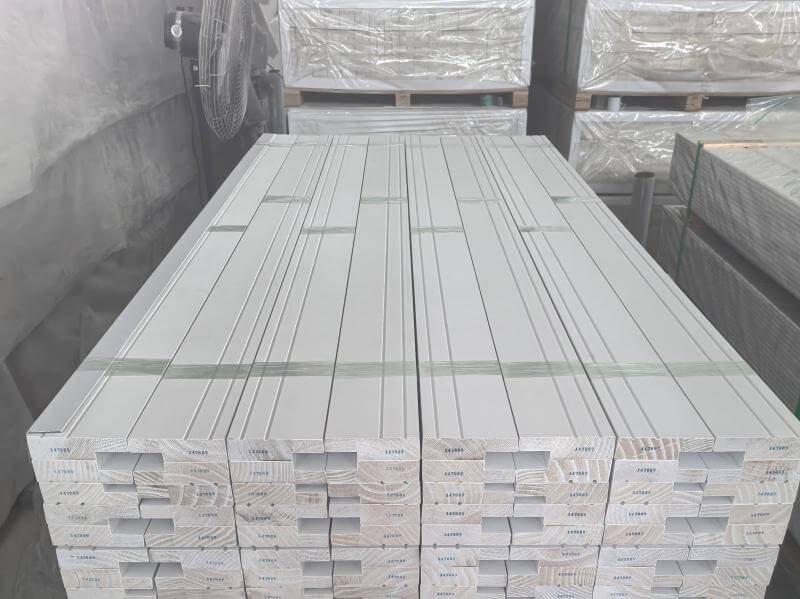
The second is joint strength. PVA adhesive is a sound choice for decorative interior profiles, but it softens under moisture and sustained load. We use PUR adhesive on all door frame SKUs. This is our own internal rule, not an industry requirement. We also state the load limits of PVA-bonded products in our technical data sheets instead of waiting for a complaint. Species matters too: pine, poplar and rubberwood suit finger-jointing, while cedar and redwood do not, because their tannins interfere with adhesive curing. Our door and window components range applies this rule, and the adhesive choice is covered in PVA or PUR? Choosing the Right Adhesive for Door Frame Moulding.
MDF. Machined MDF edges take on water quickly. In a 24-hour soak test, unsealed standard MDF edges can swell by 10–25%, moisture-resistant grade by 5–12%, and moisture-resistant grade with two-sided sealing by under 3%. After an Australian importer reported swollen ends on MDF door casings, we made end sealing the default for every Australian MDF order. It uses two coats of waterborne end sealer plus PE end caps, and QC checks it before shipment. We do not wait for the customer to ask. The full story is in The Lesson From a Return Shipment: Why MDF Moulding Edges Must Be Sealed.
MDF also has firm limits. MDF moulding is only for dry interior areas. Even moisture-resistant grades suffer irreversible damage from prolonged rain or humidity above roughly 85%. A large-section MDF door casing can also weigh 30–50% more than the same size in solid wood, which matters for the wall it is fixed to. And a chipped MDF edge is hard to repair invisibly, so damaged lengths are usually replaced.
On density, the choice is more subtle than it looks. Standard MDF (roughly 680–720 kg/m³) leaves slightly fuzzy milled edges and absorbs 15–20% more paint. Higher-density MDF (roughly 800–880 kg/m³) costs 12–18% more as a board but mills sharply and can remove one or two sanding steps. For complex profiles, total processed cost can match or beat standard density. See Is High-Density MDF Really More Expensive?
Veneered. With veneer, thickness decides the outcome. On complex S-shaped or multi-curve profiles, 0.3 mm natural veneer gave us a 3–5% sand-through rate at final inspection. For those profiles we now use 0.5 mm engineered veneer. It is more uniform, more flexible and bonds better on curves. The price is losing the random variation of natural grain, and you have to decide which matters more to your project. For reverse curves steeper than 45°, we recommend engineered veneer of at least 0.5 mm. The trade-off is explained in Natural Wood Veneer or Engineered Veneer: Which Fits Curved Profiles?
Natural veneer also cannot promise identical grain from batch to batch. For a large single space, confirm enough same-batch stock in one order. Cutting veneered moulding on site exposes a raw substrate face, which must be sealed like any MDF edge.
How do the costs really compare?
Solid wood is the most expensive per metre, but the cheapest board is not always the cheapest finished job. At equivalent sizes, solid wood moulding typically costs 30–80% more than MDF. For price-sensitive paint-grade work, MDF or finger-jointed is usually the more sensible spend. But unit price ignores what happens after delivery.
Three costs are easy to miss:
- Adhesive grade. PUR adds roughly 30–50% to adhesive cost compared with PVA. On a door frame that carries a heavy solid door, it is inexpensive insurance.
- Finishing steps. Extra joint sanding and primer coats on finger-jointed profiles add 8–12% to coating time. This is real cost in exchange for far fewer show-through complaints.
- Density choice. Higher-density MDF costs more per board but can cut sanding on detailed profiles.
A replaced shipment or a dissatisfied end customer can cost far more than any of these. When you compare quotes, ask what moisture target, end sealing, adhesive and coating thickness are included. Two quotes for "the same" moulding can be quite different products. If colour acceptance is part of your project, Understanding ΔE Color Difference explains how to write it into the specification.

Do the four types carry different compliance requirements?
Yes, but the requirements follow the substrate and the adhesive, not the product name. Regulated composite wood such as MDF, and veneered mouldings built on it, are the ones that trigger formaldehyde rules in North America. Solid timber profiles fall outside those formaldehyde rules, although other destination requirements, such as packaging rules, still apply.
The best-known rule is the California CARB Phase 2 standard2, and the US federal TSCA Title VI rules3 set the same limits. For MDF, the emission limit is 0.11 ppm, and thin MDF has a slightly higher limit of 0.13 ppm. For veneered products there are two layers to check: the core and the glue. Our veneered mouldings use E0-grade UF glue with a CARB Phase 2-certified MDF substrate. See CARB Compliance for Veneered Moulding: Core Material and Adhesive Both Matter.
Our certifications are FSC, CARB, EPA, CE, ISO 9001 and E0/E1, listed on our certifications page. Which ones your project needs depends on your destination and your customers' purchasing rules. We explain what each one means, and what documents to request, in CARB, FSC, E0/E1 Explained: A Buyer's Guide to Wood Product Certifications.
So which one should I choose? A decision checklist
Choose by finish first, then installation location, climate, load and budget. Clear-coat work rules out finger-jointed, damp locations rule out MDF, and door frames that carry a door's weight need PUR-bonded finger-jointing. Work through the five questions below in order.
- What finish will it get? Clear coat or stain rules out finger-jointed. Paint opens all four.
- Where will it be installed? Humid or wet exposure rules out MDF. True outdoor use rules out MDF and finger-jointed, and a tropical hardwood or aluminium profile is the better tool.
- What climate will it live in? Heated, dry interiors favour stable products and correct back relief on wide solid wood. Humid coastal markets require sealed MDF ends.
- Does it carry load? Door frames that carry a door's weight need PUR-bonded finger-jointing. Tell us the door weight and we will confirm the right specification.
- What is the budget and batch size? Match unit price against the total cost items above.
We should also say when we are not the right supplier.
- Our minimum order is one full container (20 ft or 40 ft). If you need less than a container, or urgent replenishment, a local distributor's stock will serve you better.
- We cannot make a flawless stain-grade finger-jointed moulding, because the joints always show under clear finishes. Choose Select grade solid wood.
- We are not the right supplier for true outdoor moulding. Our MDF and finger-jointed products are not suited to it, and a tropical hardwood or an aluminium profile is the right tool there.
For the fuller version of this list, see 5 Situations Where a Full-Container Moulding Factory Isn't the Right Fit for You.
If a container makes sense for you, we can mix 20–60 SKUs in one shipment, so you don't have to commit a whole container to a single profile. Mixing 60 SKUs in One Container explains how we control shipping damage risk, and our importers and distributors page covers how we work with buyers in that channel.
Building a range under your own brand? Choosing the right combination of materials is the best place to start. Tell us your target markets, finishes and price positioning, and we will help you map them to the right mix of solid wood, finger-jointed, MDF and veneered profiles.
Start a private-label development conversation →
Frequently asked questions
Can finger-jointed moulding be used with a clear or stained finish?
No. Finger joints remain visible under transparent or semi-transparent finishes, however precisely they are machined. This is a structural limit of the construction, not a factory fault. For clear-coat or stain-grade work, choose Select-grade solid wood or veneered moulding.
Is MDF moulding suitable for bathrooms or damp areas?
No. MDF moulding is for dry interior areas only. Even moisture-resistant grades suffer irreversible damage from prolonged rain or humidity above roughly 85%. Sealing the ends reduces moisture uptake during transit and storage, but it does not make MDF suitable for constantly damp rooms.
Is solid wood always better than finger-jointed or MDF?
No. Solid wood moves with humidity, typically costs 30–80% more than MDF at equivalent sizes, and needs back relief on wide profiles for dry-climate markets. For painted work, finger-jointed or MDF often gives better value and more stable results.
Is PVA adhesive suitable for every finger-jointed door frame?
No. PVA suits decorative interior profiles but softens under moisture and sustained load. We use PUR adhesive on all door frame SKUs. This is our own internal rule, not an industry requirement. We also state the load limits of PVA-bonded products in our technical data sheets.
What is the minimum order for moulding from Goodwood?
One full container, either 20 ft or 40 ft, which can mix 20–60 SKUs. For smaller quantities or urgent replenishment, local distributor stock is usually the better fit.