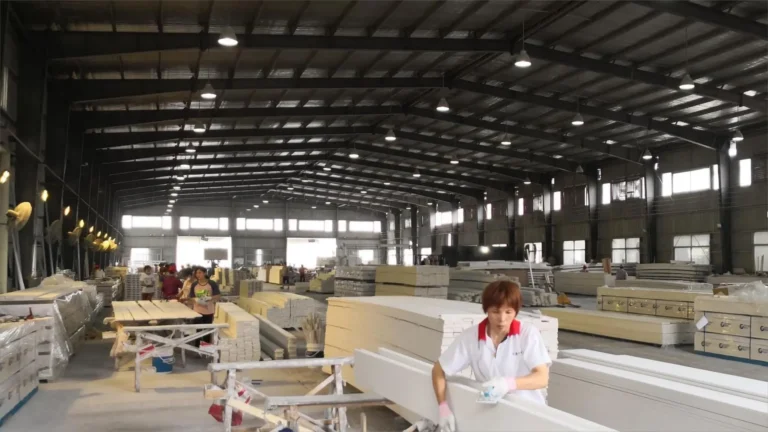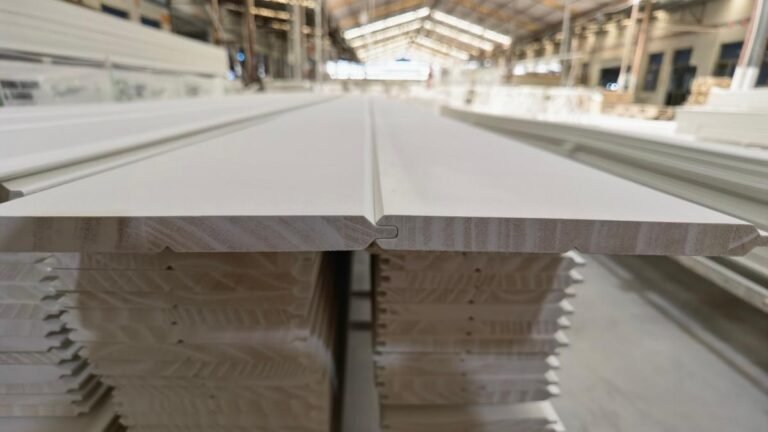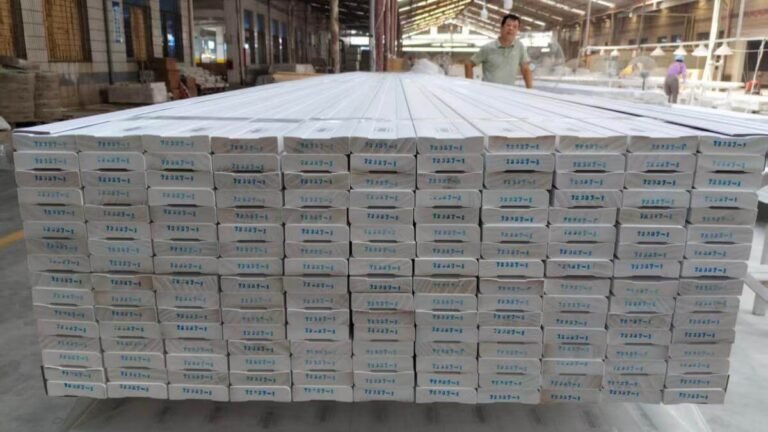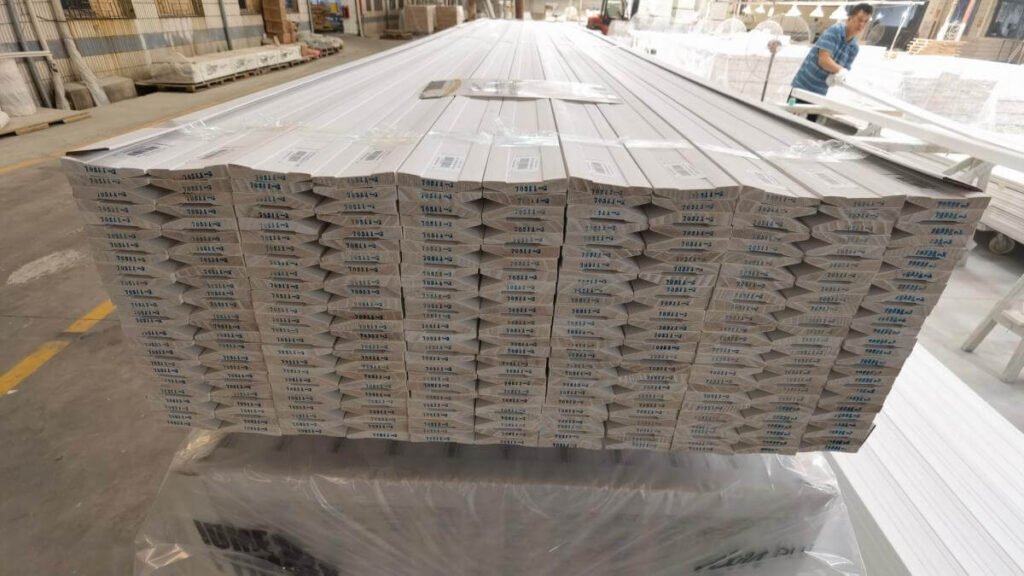
Xiamen Goodwood Industry Co., Ltd. has manufactured wood mouldings since 1995, and in nearly three decades of exporting to North America we have learned that veneered moulding CARB compliance is never a single-certificate question. A veneered profile (also spelled molding in the US) is a stack of three things: a core, a glue line and a thin layer of wood veneer. We hold CARB and EPA compliance, but the certificate is only the starting point. This article explains why the core material and the adhesive each carry their own formaldehyde risk, and how we manage both in production.
Why does veneered moulding have two separate CARB compliance layers?
Veneered moulding has two formaldehyde-relevant layers: the composite core (usually MDF) and the adhesive that bonds the veneer to it. The core is the regulated panel product. The urea-formaldehyde (UF) adhesive is the main formaldehyde source in the glue line. A compliant board therefore does not by itself settle the question for the finished profile.
California's rule is written with this in mind. It covers finished goods that contain composite wood panels1, not only the raw boards. A veneered profile built on an MDF core is a finished good containing a regulated panel, which is why careful buyers look at the whole build-up.
Solid wood moulding has no comparable problem: there is no composite panel and no laminating adhesive. A veneered profile is different. We press a 0.3 mm to 1.0 mm layer of natural or engineered veneer onto the core with heat and adhesive, and both the panel and the glue are chemistry we have to control.
For a buyer, this changes the questions worth asking. "Is your MDF CARB Phase 2 certified?" is a good first question. The follow-up matters just as much: "What adhesive system bonds the veneer, and how is it controlled?" A supplier who can only answer the first has told you about half of the compliance picture.
The rest of this article covers the two layers in turn. For the wider background on CARB, FSC and E0/E1 across markets, see our guide to wood product certifications.
What are the CARB Phase 2 formaldehyde limits that apply to the core material?
CARB Phase 2 sets formaldehyde emission limits by panel type, measured by the chamber method. For MDF thicker than 8 mm, the limit is 0.11 ppm. For MDF of 8 mm or less, it is 0.13 ppm. Federal TSCA Title VI2 sets emission standards identical to CARB Phase 2, and it has been the operative federal label since 2019.
| Composite wood product | Formaldehyde emission limit (ppm, chamber method) |
|---|---|
| Hardwood plywood (HWPW) | ≤ 0.05 |
| Particleboard (PB) | ≤ 0.09 |
| MDF, thickness > 8 mm | ≤ 0.11 |
| MDF, thickness ≤ 8 mm | ≤ 0.13 |
| NAF (no-added-formaldehyde) products | Requires third-party verification |
Source: California Code of Regulations, Title 17, Sections 93120–93120.123. These limits are the legal standard and are not a Goodwood-specific specification.
For veneered profiles on MDF cores, the 0.11 ppm figure is the one that applies in practice, and it is the mandatory floor for the US market.
We also specify our MDF cores to a European grade, E0, at 0.065 ppm or below by the chamber method. E0 and CARB Phase 2 come from different regulatory systems and are not interchangeable. Formaldehyde figures quoted from different test methods (chamber method versus perforator method) cannot be compared directly. When a buyer sends us a formaldehyde requirement, we ask which method and which standard it refers to before we confirm anything.

We pair CARB Phase 2 certified MDF cores with E0-grade UF adhesive. This combination meets North American compliance requirements while keeping production cost under control. On top of the materials, we control the hot-press window, because glue that is cured badly is a quality problem as well as a compliance problem.
This pairing is our own production choice. It is not a regulatory requirement, and other factories may choose differently. UF adhesive is the main formaldehyde source in the glue line, so choosing an E0-grade UF and pairing it with a certified core keeps the finished profile in a controlled range without the cost jump of the alternatives (covered below).
Hot-press control is the second half. From years of pressing veneer onto profiles, we know how sensitive UF adhesive is to the pressing conditions. Our normal production window is:
- Temperature: 125–135°C
- Pressure: 0.5–0.8 MPa
- Pressing time: 50–80 seconds per mm of core thickness
When the process leaves this window, we see specific failures:
| Condition | What we see |
|---|---|
| Pressure below 0.4 MPa | Bubbles at inner corners |
| Temperature above 145°C | UF adhesive cures too early, and edges open up |
| Time below 45 seconds per mm of core thickness | Adhesive in the core layer not fully activated |
A weak glue line is one more reason not to treat the press schedule as a detail. These numbers are our internal production parameters, not an industry standard, and a different core density or glue formulation may call for a different window.
How do we trace which core and which adhesive went into your shipment?
Our quality system is ISO 9001 certified and works in three stages: incoming inspection (IQC), in-process patrol (IPQC) and final inspection (FQC). We run it together with batch management and full traceability. The point of batch traceability is that a question about one shipment can be answered from records, not from memory.
This matters more for veneered moulding than for solid wood. When a buyer asks "which core and which glue?", the honest answer has to be tied to a batch. Because all processes, from log processing and finger-jointing to veneering, coating and CNC finishing, are done inside our own plant with no outsourced production, the material flow is easier to follow. We treat that as a control advantage, and we do not treat it as a substitute for documentation.

Is MDI adhesive always the better choice for CARB compliance?
No. MDI (isocyanate) adhesive can bring formaldehyde emissions close to NAF (no-added-formaldehyde) levels, but it costs roughly three to four times as much as UF and needs dedicated equipment cleaning procedures. For many veneered mouldings, E0-grade UF on a certified core is compliant and the more economical choice.
MDI is a legitimate technical route, and it is the right conversation to have when a project specifies a no-added-formaldehyde requirement. We describe it here as one of the options in the market. We are not claiming that every profile we make uses it.
| E0-grade UF adhesive | MDI adhesive | |
|---|---|---|
| Formaldehyde profile | Controlled by E0 grade; paired with certified core | Close to NAF level |
| Adhesive cost | Baseline | Roughly 3–4× UF |
| Production requirements | Standard hot-press practice | Dedicated equipment cleaning procedures |
| Best fit | Standard veneered profiles for North America | Projects that specifically require an NAF-level route |
The trade-off is cost against emissions margin. If your project or your customer demands the lowest possible formaldehyde route, tell us at the enquiry stage so the adhesive system can be discussed before quotation, not after production.
Limits worth knowing before you order
Compliance is one part of choosing a veneered profile. A few limits apply regardless of adhesive:
- MDF-core veneered moulding is for indoor, dry areas only. Even moisture-resistant MDF suffers irreversible internal damage under sustained humidity above about 85% RH or outdoor rain exposure. Veneering the surface does not change this.
- Cut ends must be sealed. When you cut a veneered profile on site, the exposed end is bare core with no veneer and no coating. Unsealed, it takes up moisture just like plain MDF.
- Natural veneer varies between batches. It comes from different trees, so grain direction and base colour shift naturally. For a large single space, confirm enough same-batch stock in your first order.
- Deep curves need a thicker veneer. A 0.3 mm natural veneer on a complex profile risks small gaps in concave curves during temperature swings in shipping or storage. For reverse curves beyond 45°, we recommend 0.5 mm or thicker engineered veneer.
None of these are reasons to avoid veneered moulding. They are the conditions under which it performs as designed. If curved profiles are your concern, read Natural Wood Veneer or Engineered Veneer: Which Fits Curved Profiles?.
What should a buyer ask a veneered moulding supplier about CARB?
A reliable supplier answers three questions without hesitation:
- What is the core material, and is it CARB Phase 2 certified?
- What adhesive bonds the veneer, and what emission grade is it?
- Can you provide the compliance documentation for each shipment?
Our export documentation includes the commercial invoice, packing list and certificate of origin, and we can supply the compliance documents your market requires. It is much easier to align on document requirements at the enquiry stage than to chase certificates once a container is booked.
FAQ
Does a CARB-certified MDF core mean the finished veneered moulding is compliant?
A certified core is necessary but does not cover the whole build-up. The veneer adhesive is a separate formaldehyde source, and California's rule also reaches finished goods containing composite wood panels1. We control both layers, and for the legal reading of a specific project we recommend confirming with your certifier or compliance adviser.
Is MDI adhesive required for CARB compliance?
No. CARB Phase 2 sets emission limits for the panel products. Our route is E0-grade UF adhesive on a CARB Phase 2 certified core. MDI is a higher-cost option for projects that specifically require an NAF-level route, and it should be raised at the enquiry stage.
Is E0 the same as CARB Phase 2?
No. They belong to different regulatory systems and use different test conditions, so the numbers cannot be compared directly. Always confirm which standard and which test method a requirement refers to.
Can veneered MDF moulding be used in bathrooms or outdoors?
No. MDF-core veneered moulding is for indoor, dry areas only. Sustained humidity above about 85% RH or rain exposure causes irreversible damage, even with moisture-resistant MDF.
Do I need to seal the ends after cutting veneered moulding?
Yes. A cut end exposes bare core with no veneer or coating, and it absorbs moisture like plain MDF. Seal every cut end after installation cuts.
Plan your veneered moulding order with the documents in place
Importers and distributors rarely buy one profile. If you are building a mixed container that includes veneered profiles, we can support 20–60 SKUs in a single container and agree the core, adhesive and documentation requirements for each SKU before production starts.
Plan your mixed-SKU container →
Related reading: Veneered Moulding · Our certifications · Quality control · CARB, FSC, E0/E1 Explained: A Buyer's Guide to Wood Product Certifications