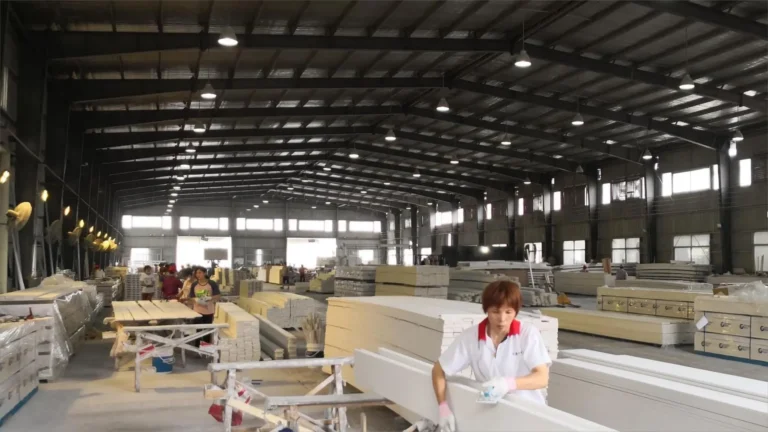
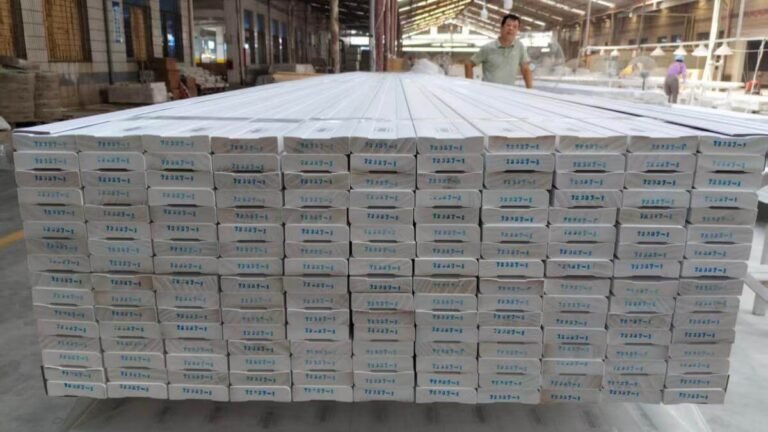
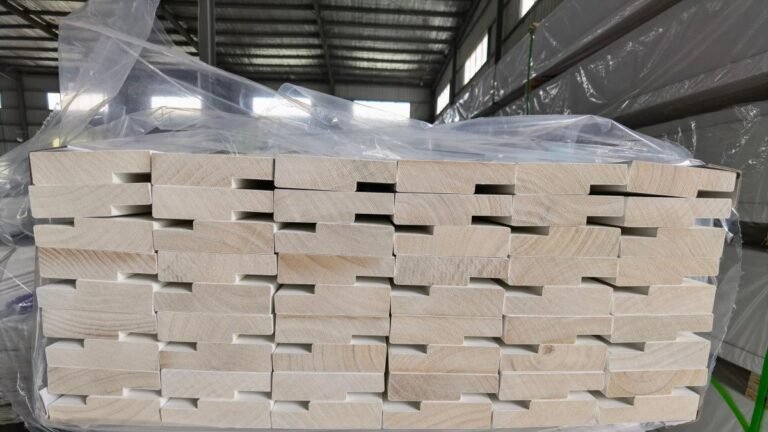
Goodwood Mouldings has manufactured wood moulding (also spelled molding in the US) in Xiamen, China since 1995. A supplier's certificate list is easy to read and hard to interpret. We hold six: CARB, EPA (TSCA Title VI), CE, E0/E1, FSC and ISO 9001. They are not interchangeable, and each answers a different buyer question. This guide explains what each one proves, what it leaves unproven, and how to check a supplier's paperwork before you place an order.
What does each certification actually certify: a product, a material, or a factory?
The six certifications cover three different things. CARB, EPA TSCA Title VI and E0/E1 address formaldehyde emissions from composite wood. FSC addresses where the wood came from. CE marking and ISO 9001 address product conformity and the factory's quality management system. None of them can stand in for another.
| Certification | What it addresses | Main market | What it does not tell you |
|---|---|---|---|
| CARB Phase 2 | Formaldehyde emission limits for composite wood (MDF, particleboard, hardwood plywood) | United States (California regulation) | Moisture resistance, wood origin, dimensional stability |
| EPA TSCA Title VI | Federal formaldehyde rules with limits identical to CARB Phase 2 | United States (nationwide) | Same as CARB |
| E0 / E1 | Formaldehyde emission grades for wood-based panels; E1 is the class defined in EN 13986, E0 is a stricter market grade | Europe | Wood origin, structural performance |
| CE marking | Conformity of construction products covered by a harmonised standard, under EU Regulation 305/2011 (CPR) | European Union | It does not apply to every moulding type |
| FSC CoC | Chain of custody for FSC-certified material | Europe, North America | Formaldehyde, strength, finish quality |
| ISO 9001 | The factory's quality management system | Global | It is not a product certification and does not guarantee any single batch |
Together, these six let us meet the entry requirements of the North American (CARB/EPA), European (CE/E1) and international (FSC/ISO 9001) systems. We treat them as a baseline. What separates one supplier from another is whether the paperwork matches the batch you receive, and that is what the rest of this guide covers. You can see our current certification overview on our certifications page.
What do CARB Phase 2 and TSCA Title VI require for composite wood mouldings?
CARB Phase 2 sets maximum formaldehyde emission limits for composite wood sold in California, and TSCA Title VI applies identical limits across the United States. For MDF thicker than 8 mm, the limit is 0.11 ppm1. Mouldings with an MDF, particleboard or hardwood plywood core fall under these rules.
| Product category | Formaldehyde limit (ppm, chamber method) |
|---|---|
| Hardwood plywood (HWPW) | ≤ 0.05 |
| Particleboard (PB) | ≤ 0.09 |
| MDF, thickness > 8 mm | ≤ 0.11 |
| MDF, thickness ≤ 8 mm | ≤ 0.13 |
Source basis: California Code of Regulations, Title 17, Sections 93120–93120.12, summarised in CARB's Phase 2 standards1.
On the federal side, EPA's TSCA Title VI rule sets limits identical to CARB's2. Since 22 March 2019, composite wood products imported into the US must be certified and labelled as TSCA Title VI compliant, rather than relying on CARB labelling alone.
Compliance has two layers, not one. In veneered moulding, formaldehyde comes from both the substrate and the adhesive. Urea-formaldehyde (UF) glue is the main source. Some producers switch to MDI (isocyanate) adhesive to bring emissions close to no-added-formaldehyde levels, but MDI costs roughly three to four times as much as UF and needs dedicated equipment cleaning procedures. Our veneered mouldings use E0-grade UF adhesive on CARB Phase 2 certified MDF substrate. This is our production choice, not an industry rule. It meets North American requirements while keeping costs under control. For the full veneered-moulding compliance path, read CARB Compliance for Veneered Moulding.
A CARB certificate on the factory wall tells you the factory has been through the system. It does not tell you what is in your container. For that, you need the batch-level documents covered in the last section.

What do E0 and E1 mean, and why can't you compare them directly with CARB numbers?
E1 is the formaldehyde emission class defined in EN 13986 for wood-based panels, set at 0.1 ppm (0.124 mg/m³) in the EN 717-1 chamber test. EN 13986 defines two classes, E1 and E2, so E0 is not one of them. "E0" is a market label for a stricter tier, and you should ask what limit and test method sit behind it.
The same E1 limit is expressed differently depending on the test method used3:
| Test method | E1 limit |
|---|---|
| Chamber method, EN 717-1 | ≤ 0.1 ppm (0.124 mg/m³) |
| Perforator method, EN 120 | ≤ 8 mg/100 g oven-dry board |
| Gas analysis method, EN 717-2 | ≤ 3.5 mg/m²·h |
Source basis: EN 13986 requirements as summarised by Fraunhofer WKI3.
It is tempting to put "0.1" next to "0.11" and conclude that an E1 board is automatically CARB-compliant, or the reverse. Do not make that shortcut. The numbers come from different test protocols and different regulatory frameworks, and the same limit can appear in different units.
Because E0 has no definition in EN 13986, an E0 claim is only as meaningful as the report behind it. We hold E0/E1 status, and we would give you the same advice about our own claim: ask for the test report and check the method and value it states.
For a US-bound order, ask for evidence under the CARB/TSCA framework. For a European order, ask for evidence under the EN framework. One market's number is not proof of compliance in the other. Our guide to why the same profile has different specs in North America, Europe and Australia covers the wider market differences.
What does FSC Chain of Custody tell a buyer, and what doesn't it?
FSC Chain of Custody (CoC) certification verifies that a processor can trace FSC-certified material through its operation. Manufacturers hold CoC certificates. Forests hold a different certificate (Forest Management). It tells you about wood origin and traceability. It says nothing about formaldehyde, strength or finish quality.
The core facts a buyer should know:
- Who needs it: companies that process or sell FSC-certified products. Manufacturers need CoC, not Forest Management certification.
- Validity: five years, with annual surveillance audits4 to maintain the certificate.
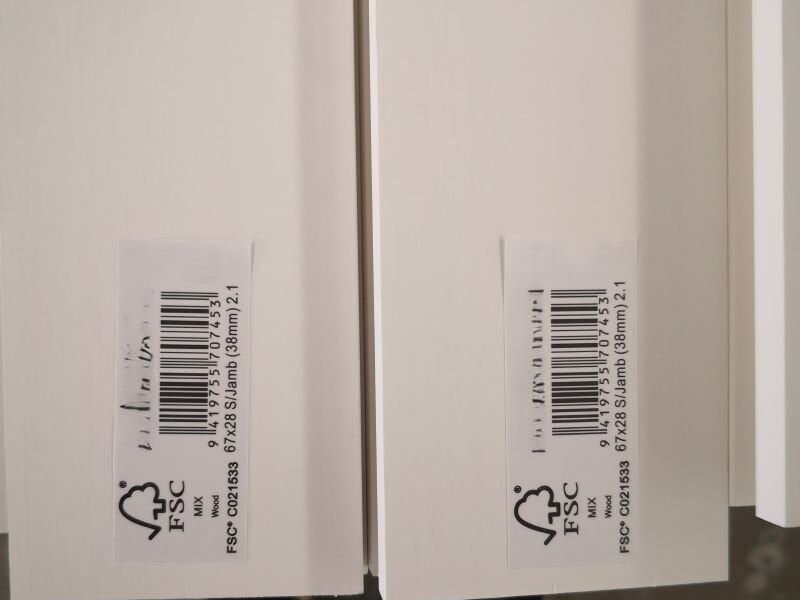
- Claims: products can be sold as FSC 100% or FSC Mix. Under the percentage system, a product can carry the FSC Mix label only when at least 70% of its input is certified or reclaimed material5.
Why buyers ask for it: in Europe it supports timber-legality due diligence, and in North America it matters for government procurement and LEED-linked projects. The practical value is traceability. If a project specification says "FSC," you have a documented chain behind the claim.
What FSC does not tell you: it does not tell you whether the MDF in your moulding meets formaldehyde limits, whether the finger joints will hold, or whether the paint will stay adhered. A factory-level certificate also differs from an order-level claim, so when FSC matters to your project, ask whether your specific order can carry the claim and where it will be stated on the shipping documents.
We state only what we hold: FSC CoC, and nothing beyond it. We make no claims here about supply-chain geolocation tracing, because that is a separate subject.
Where do CE marking and ISO 9001 fit, and what does a quality system look like on the line?
CE marking applies to construction products covered by a harmonised European standard, and it is not needed for every moulding. Under the Construction Products Regulation (305/2011)6, the manufacturer draws up a Declaration of Performance (DoP) for covered products, supported by documented factory production control. ISO 9001 certifies the quality management system7, not any individual product. Buyers use it to judge whether inspection records and traceability exist in practice.
ISO 9001 says nothing about what a product can do, but it says a lot about whether a factory can repeat its results. It is also worth knowing that ISO does not issue the certificate itself. An independent certification body audits the factory.
On our line, the quality system runs in three stages (see our quality control page for more):
| Stage | What we check | Frequency |
|---|---|---|
| IQC (incoming) | Moisture content, dimensions and appearance of each batch of timber or board, with records tied to a batch number | Every incoming batch |
| IPQC (in-process) | CNC accuracy, coating dry-film thickness, finger-joint gap | Every 4 hours at key stations |
| FQC (final) | Pre-shipment sampling at AQL 2.5 (ISO 2859-1); a failed lot is re-inspected 100% | Before shipment |
Each SKU carries its own batch number. When a container arrives with 20 to 60 different SKUs, the receiver can accept it batch by batch and trace any problem back to a production record.
This only works because the whole process happens under one roof. Our 200,000 m² automated production base covers raw timber processing, finger-jointing, veneering, coating, CNC finishing and packing, with no outsourced production. For a buyer, this means consistent quality, predictable delivery and a supply chain with fewer hand-offs. ISO 9001 is the audit framework that checks this system. It is not the system itself.

How do you verify a supplier's certificates before you place an order?
Ask for the document that matches each claim. That means third-party certification evidence for emissions, an FSC CoC certificate for origin, a third-party formaldehyde test report for the batch, and the export document set. Check the holder name, scope and date, and request them before the order is confirmed, not at shipment.
| Document | What it proves | What to check |
|---|---|---|
| CARB / TSCA Title VI third-party certification | The producer's emission compliance, certified through an approved third-party certifier (TPC) | Holder name matches the supplier; scope covers your core material |
| FSC CoC certificate | Chain-of-custody status | Holder, scope and validity; whether your order can carry an FSC claim |
| Third-party formaldehyde test report | A batch-level emission result from an independent lab | Test method matches your target market; the report refers to the batch you buy |
| ISO 9001 certificate | A certified quality management system | Certifying body and validity |
| Commercial invoice (CI), packing list (PL), certificate of origin (CO) | Customs clearance and shipment details | Descriptions match across all three documents |
The cheapest time to find a missing document is before the order, not at shipping. We recommend writing the required document list into the order confirmation, so both sides know what will travel with the container.
Two honest limits are worth keeping in mind:
- A certificate is not a batch guarantee. It shows a system exists and has been audited. Only a batch-level test report and incoming inspection tell you about the goods in front of you.
- A formaldehyde certificate does not make a product waterproof. MDF mouldings are for interior dry areas only. Even moisture-resistant (MR) grade MDF will suffer irreversible internal damage under prolonged outdoor exposure or sustained humidity above 85% RH. Emission compliance and moisture performance are separate properties, so choose the material for the environment first and check the certificates second.
Certificates are one of several documents that travel with an export order. Packaging has its own compliance line, covered in ISPM 15 Wood Packaging Compliance. If you are planning a multi-SKU shipment, see how we control damage risk when mixing 60 SKUs in one container. If you are still choosing materials, start with how to choose between solid wood, finger-jointed, MDF and veneered moulding.
The short version
Treat the six certifications as six different answers. CARB and TSCA Title VI answer the US formaldehyde question. E1 answers the European one, using different test methods, and E0 needs a stated limit behind it. FSC answers where the wood came from. CE answers whether certain construction products conform to EU rules. ISO 9001 answers whether the factory can repeat what it does. Match each certificate to the claim it supports, and ask for batch-level evidence before the order is confirmed.
Frequently asked questions
Does a CARB or E1 certificate mean MDF moulding can be used in humid areas?
No. Formaldehyde certificates cover emissions only, not moisture performance. MDF mouldings are for interior dry areas only. Even moisture-resistant (MR) grade MDF suffers irreversible damage under prolonged outdoor exposure or sustained humidity above 85% RH.
Can I compare an E1 or E0 figure directly with a CARB ppm limit?
No. They come from different test protocols and regulatory frameworks, and the same limit can be expressed in different units. E1 is defined in EN 13986, which defines no E0 class, so ask what limit and method any E0 claim refers to.
Does FSC certification mean the moulding's formaldehyde level is compliant?
No. FSC Chain of Custody tells you where the wood came from and that the processor can trace it. It says nothing about formaldehyde emissions, strength or finish quality. Check CARB/TSCA Title VI or E1 evidence separately.
Is ISO 9001 a product certification?
No. ISO 9001 certifies a factory's quality management system, not individual products. It shows that inspection and traceability processes exist and are audited, but it does not guarantee that any single batch meets your specification.
Which certification documents should I ask a supplier for before ordering?
Ask for third-party certification evidence for emissions, the FSC CoC certificate if origin matters, a batch-level formaldehyde test report, an ISO 9001 certificate, and the export set (CI, PL, CO). Write the list into the order confirmation. See our FAQ page for more.
Confirm the documents for your project
If you are specifying mouldings for a project, tell us your target market, material and finish, and we will walk you through the certification documents that apply. Confirm our current certification documentation for your project.
See how California's Phase 2 formaldehyde limits apply to hardwood plywood, particleboard and MDF. ↩
Learn how EPA's TSCA Title VI rule mirrors the CARB limits and when third-party certification and labelling became mandatory. ↩
Explore how the E1 limit is expressed across the chamber, perforator and gas-analysis test methods. ↩
Find out how FSC chain-of-custody certificates are issued for five years and maintained through annual audits. ↩
Read how the FSC Mix percentage system decides when a product may carry the label. ↩
Read the regulation text on declarations of performance and factory production control for construction products. ↩
See what ISO 9001 covers, and why it describes a management system rather than a product. ↩