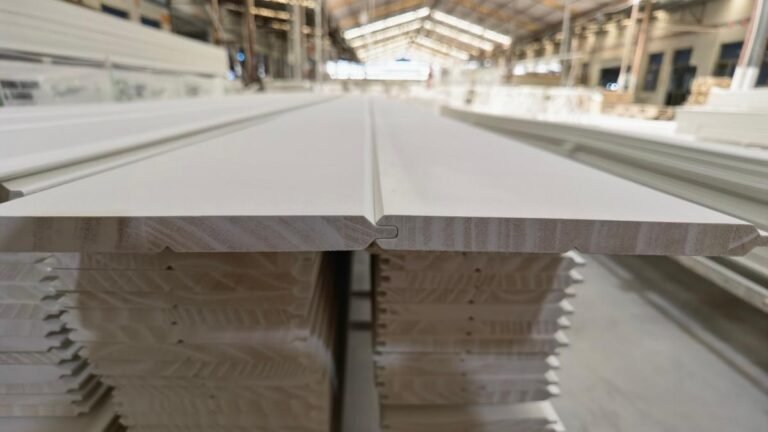
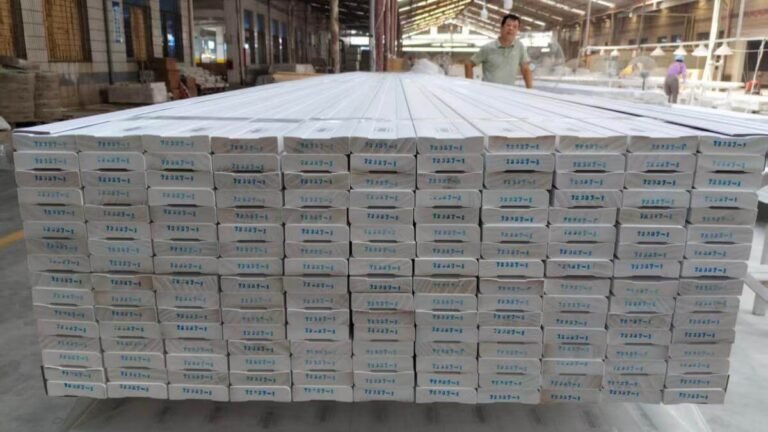
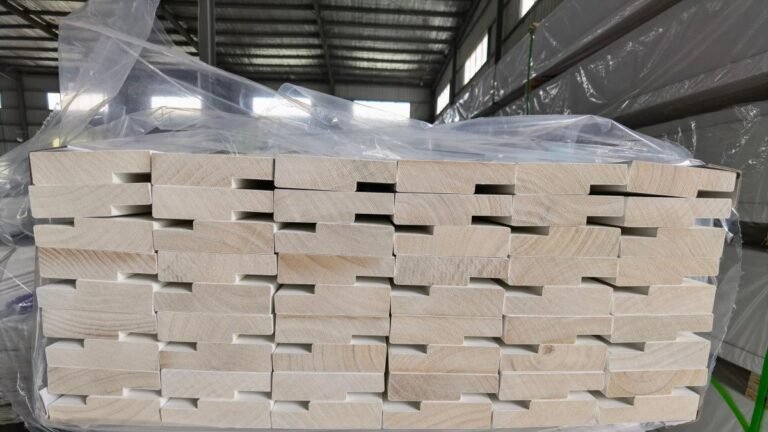
Since 1995, we have been making wood moulding (also spelled molding in the US) in Xiamen, Fujian. Our 200,000 m² production base covers log processing, finger-jointing, veneering, coating, CNC machining and packing, all in-house. After nearly three decades, one question keeps coming up: a buyer sends a single profile drawing for several destinations, then asks why the specification sheet is different for each one.
A profile drawing defines the shape, not the specification. Below, we explain what changes between North America, Europe and Australia, why it changes, and which items to lock down before you place an order.
Why does one profile drawing need three different specifications?
The cross-section can be identical, but three variables change with the destination: climate, regulation and purchasing habit. Climate sets the moisture target. Regulation sets formaldehyde certification and packaging rules. Local habit sets standard lengths and terminology. The specification is the profile plus all three.
| Item | North America | Europe | Australia |
|---|---|---|---|
| Formaldehyde compliance | CARB Phase 21 / TSCA Title VI2 (mandatory for composite wood products) | E0 or E1, depending on the country | E0-equivalent, referencing European levels |
| Sustainability certification | FSC3 (expected in higher-end projects) | FSC (requested in a growing number of markets) | FSC (requested for green-building projects) |
| Wood packaging | ISPM 15 (heat-treatment mark) | ISPM 15 | ISPM 154; Australia applies its own biosecurity import conditions |
| Our shipping moisture target (solid wood) | 8–10% | 10–12% | 10–12% (southern/coastal); 12–14% (hot, humid regions such as Queensland) |
| Length convention | Imperial (8 ft / 12 ft / 16 ft) | Metric (2.7 m / 3.0 m / 4.0 m) | Metric (2.7 m / 3.6 m / 5.4 m) |
| Spelling and terms | molding, baseboard, casing | moulding (British spelling) | moulding, skirting |
None of these differences is a pricing excuse. Each one traces back to a physical cause (climate) or a legal one (regulation and import rules). Each can go wrong in a way that only shows up months after delivery.
Market-specific detail lives on our market pages for the United States, Canada, United Kingdom and Australia.
How does the destination climate change the moisture content target?
Wood keeps trading moisture with the surrounding air until the two balance, so the target must match the destination. We ship solid wood at 8–10% moisture content (±1%) for North America, 10–12% (±1%) for Europe and for southern or coastal Australia, and 12–14% for hot, humid regions such as Queensland.
A heated North American home in winter sits at roughly 20–35% indoor relative humidity. A European maritime climate sits at 40–60%. Suppose a profile leaves the factory at 12–14% and is installed in that heated home. It dries fast, and the undecorated back face loses moisture faster than the finished front. The difference in shrinkage bends the piece into a shallow curve, which is called cupping.
In our experience, about 90% of complaints trace back to moisture content. The typical pattern is slight cupping in solid wood moulding, 60–90 days after arrival. It almost always comes down to shipping moisture that was too high for the destination. We look at one real case of this in Why Your Solid Wood Baseboard Warped Within 3 Months.
| Destination | Typical indoor condition | Our standard shipping moisture content |
|---|---|---|
| North America | Winter heating, indoor RH about 20–35% | 8–10% (±1%) |
| Europe | Maritime climate, indoor RH about 40–60% | 10–12% (±1%) |
| Southern / coastal Australia | Milder, more humid | 10–12% |
| Hot, humid regions (e.g. Queensland) | Warm and humid | 12–14% |
Reaching the target at the kiln door is not the whole story either. In thick solid stock, the core can stay 3–5% wetter than the surface, and we treat that stock as needing a 1–2 week equalisation period before machining. That detail deserves its own article, which we wrote up in Moisture Content Passed Inspection — So Why Did It Still Warp?.
Moisture control also has a limit. Solid wood moves with humidity, and no target removes that. For solid wood mouldings 90 mm wide or more in a North American heated home, dimensional change can reach 0.5–2.0 mm, depending on species, starting moisture content and site conditions. A correct target lowers the risk but cannot eliminate it. If your project needs zero visible movement, painted MDF moulding or a veneered profile on a stable core is the more honest choice.
One more point, and this is our internal rule, not an industry standard: for North American orders, solid wood mouldings 90 mm wide or more are produced with a back relief cut. For wide solid wood profiles, we treat it as factory-standard, not an optional extra.
Which formaldehyde and sustainability certifications does each market expect?
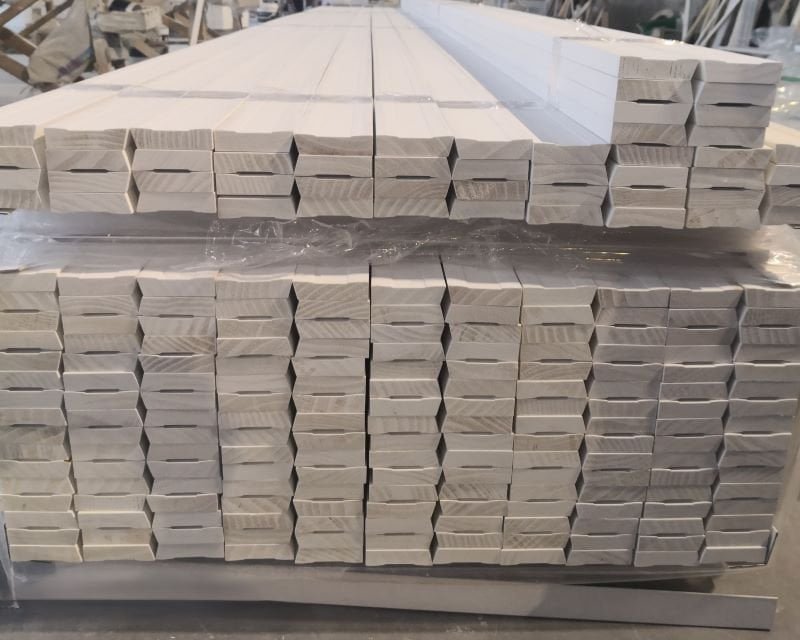
North America requires CARB Phase 2 and TSCA Title VI compliance for composite wood products. Europe expects E1 or E0, depending on the country. Australia generally looks to European-equivalent levels. FSC is asked for in higher-end North American projects, a growing number of European markets and Australian green-building projects.
| Standard | Market | Key threshold or requirement | Basis |
|---|---|---|---|
| CARB Phase 21, MDF thicker than 8 mm | United States | ≤0.11 ppm | California Code of Regulations, Title 17, §93120–93120.12 |
| CARB Phase 2, MDF 8 mm or thinner | United States | ≤0.13 ppm | Same regulation |
| TSCA Title VI2 | United States (federal) | Same emission limits as CARB Phase 2; compliance labelling required from March 2019 | US EPA |
| E1 | Europe | ≤0.1 ppm, climate chamber method | EN 13986:2004 + A1:2015 |
| E0 | Europe / premium markets | ≤0.065 ppm, climate chamber method | EN 13986:2004 + A1:2015 |
| FSC Chain of Custody3 | All three | Certificate issued through an accredited body, with annual audits | FSC |
Do not compare formaldehyde numbers across systems without checking the test method. A perforator-extraction value and a climate-chamber value measure different things, so a limit quoted in mg/L cannot be set directly against one quoted in ppm.
CARB and TSCA Title VI apply to products containing composite wood, such as MDF-based and some veneered mouldings. They are not a requirement for solid wood. For the full comparison of how each certification works, see our guide CARB, FSC, E0/E1 Explained: A Buyer's Guide to Wood Product Certifications.
We hold FSC, CARB, EPA, CE, ISO 9001 and E0/E1 certifications; details are on our certifications page. Together they cover the North American, European and international quality-system requirements. Before you order, ask which of these documents your destination actually requires, so the paperwork is settled before the container is.
Why do standard lengths, terminology and packaging also vary?
Lengths follow each market's measuring habit and retail stocking: imperial in North America, metric elsewhere, with different standard sets in Europe and Australia. Terminology follows the same logic. Packaging differs because import rules differ: wood packaging must meet ISPM 15, and Australia applies its own biosecurity import conditions on top.
| Market | Standard lengths | Common product terms |
|---|---|---|
| North America | 2438 mm (8 ft) / 3658 mm (12 ft) / 4877 mm (16 ft) | molding, baseboard, door casing, trim |
| Europe | 2700 / 3000 / 4000 / 5000 mm | moulding; architrave and skirting in British usage |
| Australia | 2700 / 3600 / 5400 mm | moulding, skirting, cornice |
| Mixed export | 2440 / 3050 mm (approximately 8 ft / 10 ft) | mixed |
Terms matter more than they look. "Casing" and "architrave" describe the same product to different readers, and a quotation sheet using the wrong word invites avoidable questions. If you source both, see our architrave and skirting board ranges.
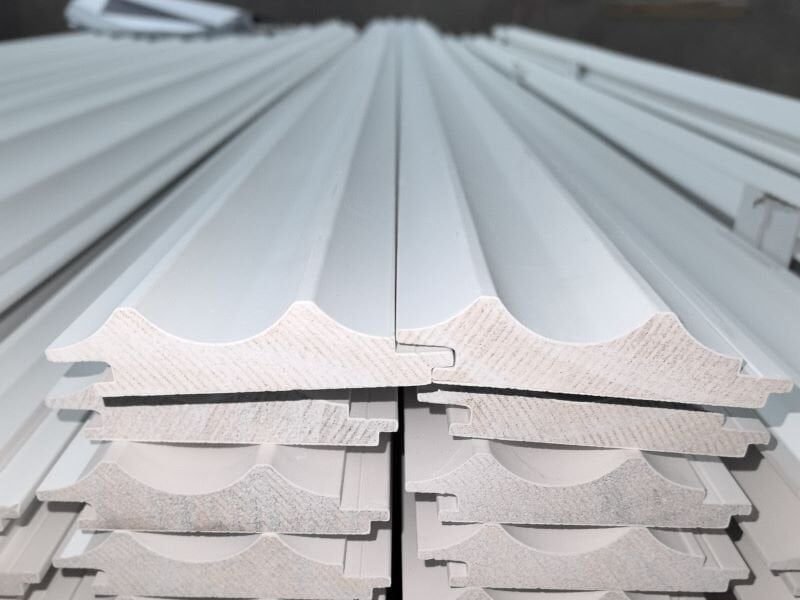
ISPM 15 is the international standard for solid wood packaging. The common compliant treatment is heat treatment, with the wood core held at 56°C for 30 minutes5. Methyl bromide fumigation is the other approved route, but we do not recommend it. Whatever the route, your quotation should state which treatment and marking applies to the pallets. We cover the packaging details in ISPM 15 Wood Packaging Compliance: The Detail Most Buyers Overlook.
Transit time differs by destination too. Ocean freight from Xiamen takes roughly 12–15 days to Los Angeles and 18–22 days to Sydney. Over a long voyage, daytime warming and night-time cooling can leave condensation on cargo, which is known as container rain. Our countermeasures are desiccant inside the container and fully sealed PE film wrap instead of bare bundles. What Happens to Your Wood Moulding During 12 Days at Sea walks through this in detail.
Australian orders add one more rule of ours. For every MDF order to Australia, both end faces must receive end-sealing paint, and our pre-shipment QC checks include it. This is our internal rule, not an industry standard, and it comes from a large return we learned from. You can read that story in What We Learned When an Importer's MDF Door Casing Swelled After Ocean Shipping. End sealing reduces moisture uptake at cut faces, but MDF remains a material for dry interior areas only. Even moisture-resistant grades suffer irreversible internal damage from outdoor rain or sustained humidity above 85% RH. For a wet area, use a different material.
How should I specify a mixed-market order without creating conflicts?
Lock five items per destination before ordering: moisture target, certification documents, standard lengths, terminology, and packaging with end-sealing requirements. When one container serves several markets, give each SKU its own destination specification, batch number and moisture record, so nothing is averaged out.
- Moisture target. Name the destination climate, not just the country.
- Certification documents. State which of CARB/TSCA, E0/E1 and FSC you need on file for this shipment.
- Standard lengths. Choose from the market's standard set, or flag early that you need something different.
- Terminology and labelling. Use the spelling and product names your customers use.
- Packaging. Confirm the wood packaging treatment and, for MDF to humid regions, end sealing.
If the same profile goes to two climates, the clean way to handle it is as two SKUs on the paperwork, because one SKU cannot carry two moisture targets. We load 20–60 SKUs in one container. Each SKU carries its own batch number and moisture record, so you can inspect and trace them separately on arrival; our quality control process explains how those records are kept. We also never put MDF and solid wood on the same pallet, because their weights differ and the MDF can deform under load. The full method is in Mixing 60 SKUs in One Container: How We Control Shipping Damage Risk.
This approach has limits. Our minimum order is a full container (20 ft or 40 ft), so if you need less than one container, local distributor stock will serve you better. Production plus ocean freight takes 21–30 days at best, so for urgent orders under 21 days, local stock is the better source too.
If you are choosing between materials for each market, Solid Wood, Finger-Jointed, MDF or Veneered: How to Choose the Right Moulding compares all four.
Frequently asked questions
Can I use one moisture content target for all markets?
No. Indoor humidity differs sharply: about 20–35% RH in a heated North American home in winter, about 40–60% in a European maritime climate. We ship solid wood at 8–10% for North America and 10–12% for Europe, so the same profile ordered for both markets should be specified as two SKUs.
Do CARB and TSCA Title VI apply to solid wood moulding?
They apply to composite wood products such as MDF, particleboard and hardwood plywood, and to finished goods made from them. For an MDF-core or veneered profile going to the United States, ask for the compliance documents. For pure solid wood, the rules do not target the product itself, although wood packaging rules such as ISPM 15 still apply.
Is MDF moulding suitable for humid coastal regions like parts of Australia?
Only for interior dry areas. MDF is not suitable for outdoor use or sustained humidity above 85% RH, even in moisture-resistant grades. For Australian MDF orders we seal both end faces as a rule and check this before shipment, which reduces moisture uptake at cut faces but does not make MDF suitable for wet areas.
Does the right moisture target stop solid wood from moving?
No. It lowers the risk, but solid wood still responds to humidity. Solid wood mouldings 90 mm wide or more can change dimension by 0.5–2.0 mm in a North American heated home. If your project cannot tolerate movement, choose painted MDF or a veneered profile on a stable core instead.
Can one container carry SKUs for more than one market?
Yes. We load 20–60 SKUs per container, each with its own batch number and moisture record. Mark the destination specification on each SKU line. If your order is smaller than a full container, we are not the right source, and local stock will be faster and cheaper.
Plan your mixed-SKU container
Sending one profile drawing to several markets? Send us the drawing and the destinations. We will come back with the moisture target, certification documents, lengths and packaging for each SKU before you commit to a container.
Plan your mixed-SKU container →
Explore how CARB's composite wood regulation sets formaldehyde limits and labelling duties. ↩
See how the EPA's TSCA Title VI rule aligns federal formaldehyde standards with California's. ↩
Learn what FSC chain of custody certification covers and how annual audits work. ↩
Check how Australia's biosecurity conditions apply ISPM 15 to imported wood packaging. ↩
Find out how the ISPM 15 heat treatment requirement is defined. ↩