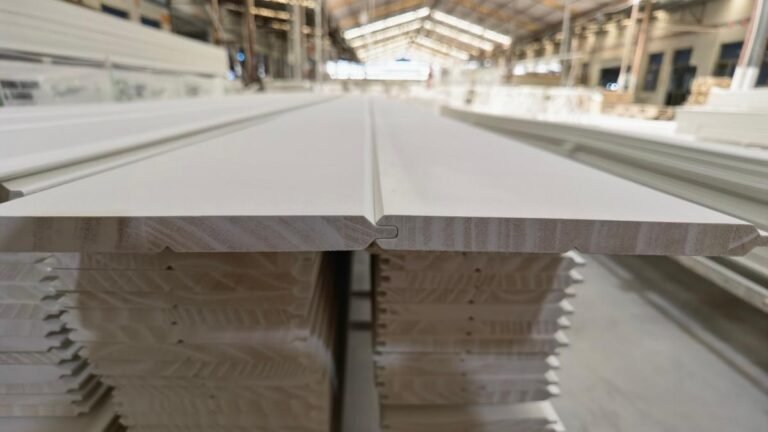
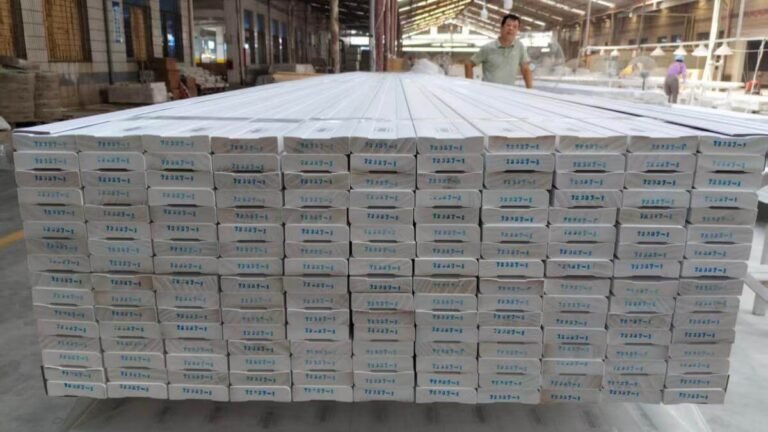
We have been making wood mouldings (also spelled molding in the US) in Xiamen since 1995. Log processing, finger-jointing, veneering, coating, CNC machining and packing all happen inside our own factory. After nearly three decades, one pattern still explains most of the complaints we investigate: in our experience, around 90% of moulding complaints trace back to moisture content. A solid wood baseboard that looks perfect on delivery and starts to cup 60–90 days later is the textbook case. This article explains the mechanism and what we changed in our own production because of it.
What is cupping, and why does it show up 60–90 days after installation?
Cupping is a board curling across its width because one face loses moisture faster than the other. In solid wood baseboards it typically appears 60–90 days after installation, when a shipment with high moisture content meets its first winter of central heating and the indoor air turns very dry.
The scenario we see most often is consistent. Solid wood moulding leaves the factory at 12–14% moisture content (MC) and is installed in a North American home where winter heating drops indoor relative humidity below 30%. Wood trades moisture with the surrounding air1, and here it loses moisture quickly. The back of the board, the undecorated face against the wall, dries faster than the finished front face. The two faces shrink by different amounts, and the board cups.
This timing is why the problem is so often blamed on the installer or the paint. The cause was set weeks earlier, at the kiln and in the shipping container.
Width makes it worse. Solid wood mouldings wider than 75mm (3 inches) with no back relief cut are significantly more likely to cup. A back relief, a shallow groove milled into the back face, lowers that probability. It does not eliminate it, and we won't claim otherwise.
How much does moisture content matter, and what does "passed inspection" really mean?
Moisture content is the most common root cause of moulding complaints, but a passing kiln reading does not mean a board is ready to ship. Surface and core dry at different rates. We treat MC as a staged process with checkpoints, not as one number on a meter.
Here is how it moves through our process:
| Stage | Moisture content | What happens |
|---|---|---|
| Incoming logs | 40–80% (freshly felled can exceed 100%) | Natural moisture at arrival |
| Air-drying | Down to 20–25% | Boards enter the kiln from here |
| Kiln target: North America | 8–10% | Winter indoor humidity is 20–35% |
| Kiln target: Europe | 10–12% | Maritime climate, indoor humidity 40–60% |
| Kiln target: Australia (southern/coastal) | 10–12% | Moderate humidity |
| Kiln target: Australia (Queensland, hot-humid regions) | 12–14% | Avoids over-drying for humid climates |
A board that passes at the kiln exit can still fail in the field. Wood has a shell-and-core difference: the surface dries first and the core lags behind. In solid stock thicker than 40mm, the core can still read 3–5% higher than the surface when the board leaves the kiln. If that stock is machined without 1–2 weeks of equalisation, cutting releases internal stress and the finished piece can bow or crack. This is shop-floor knowledge you won't find in a textbook, and it is one reason we separate "dried" from "ready to machine" from "ready to ship."
Our quality control process uses three measurement methods, each for a different job:
- Pin-type resistance meter: a fast in-process check, accurate to about ±2% and suited to MC below 30%. It is a screening tool, not proof.
- High-frequency capacitance meter: non-destructive, so it works on coated or veneered product.
- Oven-dry method (AS/NZS 1080.1)2: certification-grade accuracy but destructive. We use it for final confirmation of export batches.
Why did a 150mm wide baseboard cup by about 2.5mm? A worked example
Because the board lost moisture faster than it could stay flat. A 150mm primed poplar baseboard shipped at 11% moisture content dried by roughly four points in a heated North American home, shrank unevenly, and, with no back relief, cupped by about 2.5mm within three months.
Here is the chain of numbers from one case we investigated, a 150mm × 18mm solid poplar baseboard, primed:
- Shipping MC: 11%.
- Winter indoor RH after heating began: about 22%.
- MC in service dropped to about 7%.
- Differential shrinkage: over 3%, and with no back relief the board had nothing to relieve that stress.
- Result: about 2.5mm of cup.
These figures come from one case. They show how the mechanism works, not what every board will do.
The physics also pointed to the fix. Our internal rules now say:
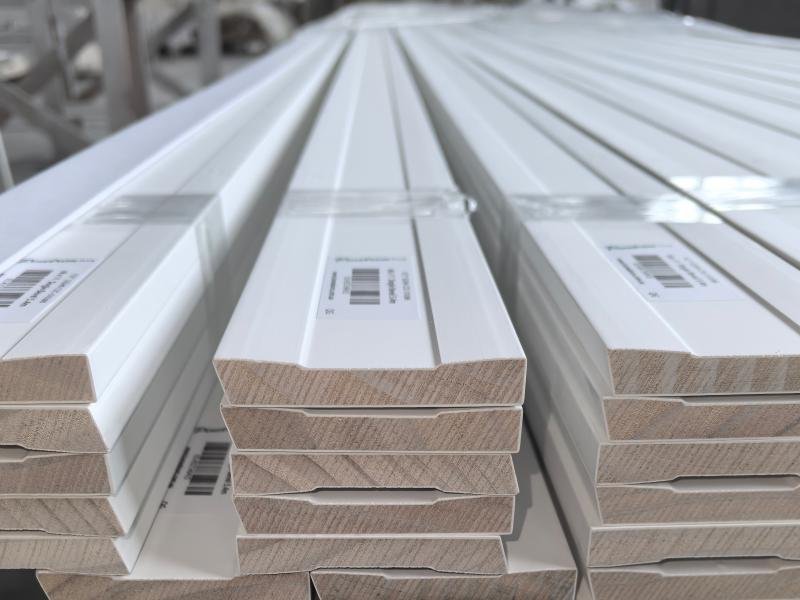
- All solid wood mouldings 90mm and wider on North American orders get back relief: 1–2 grooves, 3–4mm deep.
- Shipping MC target moved from 11% to 9% (±1%). That is the practical execution of our 8–10% North American kiln target.
These are our internal rules, not an industry standard. Back relief is not an option on wide solid wood moulding for North American orders. It is how those pieces leave our factory. We built it into the standard process so no customer has to request it.
Is solid wood the wrong choice, then? What solid wood moulding can and cannot do
No, but it has physical limits that no supplier can remove. Solid wood expands and shrinks with humidity. On profiles 90mm and wider in a North American winter, dimensional change of 0.5–2.0mm is normal, depending on species, starting moisture content and site conditions.
We would rather you hear the limits from us than find them on site:
- It moves. Movement with humidity is a property of the material. Good drying, back relief and correct MC targets reduce it but cannot remove it.
- Colour varies by batch. Natural colour changes with origin and growing conditions, and no supplier can fully eliminate it. If a project needs tight colour consistency (ΔE below 1.0), choose a painted moulding, not clear-finished solid wood.
- Knots can appear on show faces. Even top-grade stock, graded by appearance with reference to EN 9423, may contain small live knots. For stain-grade work needing a defect-free face, specify select-grade solid wood or consider veneered moulding.
- It costs more. Solid wood moulding runs 30–80% above MDF for equivalent sizes. For price-sensitive paint-grade projects, MDF moulding (interior, dry areas only) or finger-jointed moulding (paint-grade only) may be the more sensible choice.
Solid wood still earns its place when the grain will be seen, as in stain-grade work. Where it will be painted and the budget matters, be honest about the alternatives.

What should importers check before ordering wide solid wood baseboards?
Check four things: whether shipping moisture content matches the destination climate, whether profiles 90mm and wider have back relief, whether you get moisture records per batch, and whether the supplier controls equalisation on thick stock. If a supplier cannot explain these, you may end up finding out in the field.
| Ask your supplier | What we do | Why it matters |
|---|---|---|
| What MC target do you ship to for my destination? | North America 8–10% (9% ±1% in practice); Europe and southern/coastal Australia 10–12% | Shipping MC out of line with the destination climate is the root cause in the cases above |
| Do profiles 90mm+ get back relief? | Yes, on North American orders: 1–2 grooves, 3–4mm deep | Reduces cupping risk on wide profiles |
| Do I get MC records per batch? | Each SKU carries its own batch number and moisture record | Lets you check and trace on arrival |
| How do you handle thick stock? | 1–2 weeks equalisation for stock over 40mm before machining | Prevents stress release after cutting |
The batch record matters most on mixed containers. We ship 20–60 SKUs in a single container, so each SKU needs its own batch number and MC record for you to verify on receipt. For how specifications differ by destination, see our United States market guide.
Warping within three months is rarely a sign of "bad wood." It is usually a mismatch between shipping moisture content, the destination climate and the profile design. Suppliers who can walk you through that chain are worth keeping. If yours can't, that tells you something too.
Plan your mixed-SKU container
If you are specifying wide solid wood profiles for a North American or Australian import programme, we can walk through the moisture target, back relief and batch records for your destination before you place an order. Our minimum order is a full container (20ft or 40ft), so if you need less than that, a local stockist is the better route.
Plan your mixed-SKU container →
Frequently asked questions
Can back relief stop a solid wood baseboard from cupping completely? No. A back relief groove reduces the probability of cupping, especially on profiles wider than 75mm, but it does not remove it. Solid wood always moves with humidity. What controls the outcome is the combination of shipping moisture content, back relief and the destination climate.
What moisture content should solid wood baseboards ship at for North America? Our kiln target for North America is 8–10%, executed in practice as 9% ±1%. Higher shipping values, such as 12–14%, are the pattern we most often see behind cupping complaints after the first heating season.
If a board passed the kiln moisture reading, is it ready to ship? Not necessarily. Thick stock, over 40mm, can have a core reading 3–5% higher than its surface at kiln exit. Without 1–2 weeks of equalisation before machining, cutting can release stress and cause bowing or cracking.
Is solid wood or MDF better for painted baseboards? Neither is better in every case. Solid wood costs 30–80% more than MDF, moves with humidity, and suits work where grain will be seen. MDF is only suitable for interior dry areas. Weigh cost, colour consistency needs and site humidity before choosing.