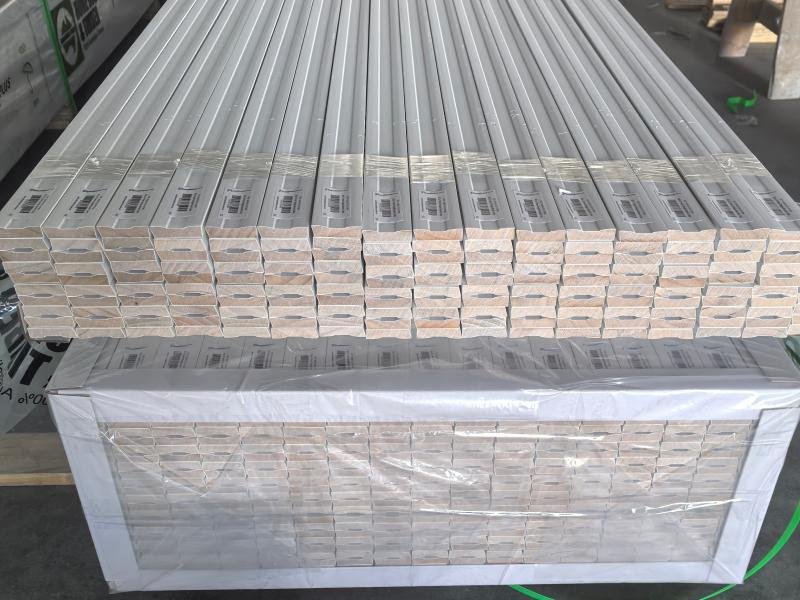
Inside Our 200,000㎡ Manufacturing Facility
Every stage of production -- from log intake to export packaging -- happens inside our own facility in Xiamen, Fujian. No subcontracted production stages, which means consistent quality and predictable lead times.

End-to-End Manufacturing
Our Production Process
Every stage of manufacturing is completed within our own facility -- no subcontracting at any point in the chain. This integrated approach directly supports batch-to-batch quality consistency, stable lead times and a supply chain that remains fully within our control.
Stage 01
Log Processing
Stage 02
Finger-Jointing
Stage 03
Veneering
Stage 04
Coating
Stage 05
CNC Finishing
Stage 06
Inspection & Packaging
01 -- Log Processing
Raw Material Intake & Preparation
Incoming logs and lumber are assessed, graded and kiln-dried on-site before entering the production line. Controlling this stage in-house lets us maintain consistent moisture levels and material grade ahead of all downstream processes.
02 -- Finger-Jointing
Engineered Length & Stability
Finger-jointed blanks are produced from pre-graded sections, bonded with structural adhesive and cured before profiling. This stage is suited to primed or paint-grade applications; finger-jointed profiles are not recommended where transparent lacquer finishes are specified.
03 -- Veneering
Natural & Engineered Veneer Application
Both natural wood veneer and engineered veneer are applied over MDF or finger-jointed cores in our own veneering shop. Running this stage internally allows consistent grain matching and colour uniformity across large production runs.
04 -- Coating
Primer, Paint & Lacquer Lines
Our coating facility covers primer sealing, solid paint and clear lacquer lines. Keeping coating in-house -- rather than outsourcing to a third-party finishing shop -- is the primary reason we can guarantee batch-to-batch colour consistency for multi-year supply programmes.
05 -- CNC Finishing
Made-to-Print Profile Accuracy
CAD/CNC-driven tooling allows us to produce profiles directly from customer drawings or physical samples. This is the stage that underpins our discontinued-profile replication service and custom OEM profile development for project buyers.
06 -- Inspection & Packaging
IQC · IPQC · FQC Quality Gates
Three quality checkpoints -- incoming (IQC), in-process (IPQC) and final (FQC) -- precede packaging. We support private-label packaging, mixed-SKU container loading of 20-60 SKUs per container, and complete export documentation including CO, PL and CI.
Manufacturing Philosophy
Why In-House Production Matters
Among wood moulding manufacturers, it is common for smaller and mid-scale operations to outsource coating, veneer purchasing or even profiling to third-party subcontractors. Fully integrated, end-to-end in-house production is a configuration more typically associated with scaled facilities -- and it has direct, measurable consequences for trade buyers.
Quality Consistency
When coating and veneering are subcontracted, colour variation between batches becomes a known risk. Running both stages in-house under our own QC checkpoints removes that variable -- which matters most for door and window manufacturers running multi-year supply programmes.
Lead Time Reliability
Every handoff to an external subcontractor introduces a scheduling dependency outside your supplier's control. Keeping all six production stages on our own floor means lead times are driven by our own production scheduling -- not by a subcontractor's availability.
Supply Chain Control
Importers and distributors managing 20-60 SKUs per container need a supplier who can coordinate mixed loads, certifications and private-label packaging without delegating to third parties. Vertical integration is what makes that coordination reliable at scale.
An honest note: full in-house production does not eliminate all risk -- tooling wear, raw material availability and port scheduling can still affect individual orders. What it does eliminate is the category of delays and quality variations that originate from subcontracted stages outside our facility.
Production overview -- Goodwood Mouldings facility, Xiamen, Fujian

Explore Further
Learn more about how our manufacturing standards translate into verifiable certifications and measurable quality outcomes.
Certifications
FSC, CARB, EPA, CE, ISO 9001 and E0/E1 -- how each certification applies to trade sourcing and what it means in practice for US, Canadian and UK buyers.
Quality Control
How IQC, IPQC and FQC checkpoints work across our production line -- the specific criteria applied at each stage and why three inspection gates matter for high-volume trade orders.
Want to Discuss a Production Timeline?
Tell us your profile type, target volume and delivery window. We'll provide an initial capability assessment and, where relevant, a production schedule outline within a few business days.