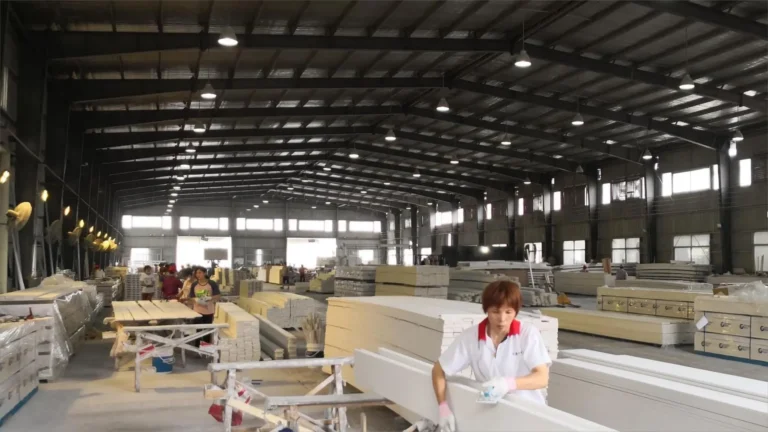
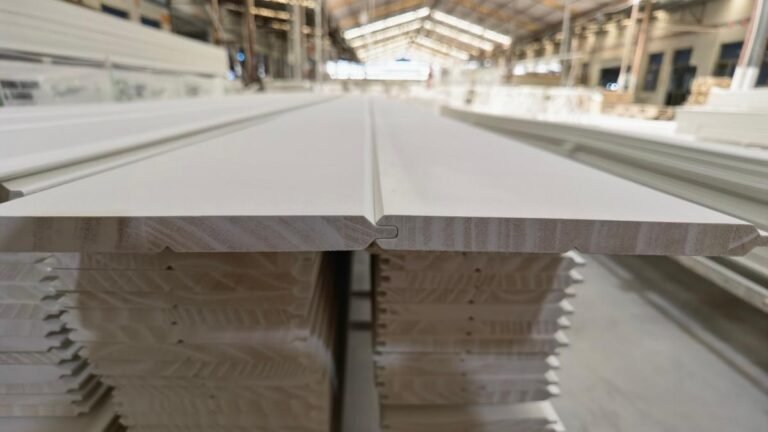
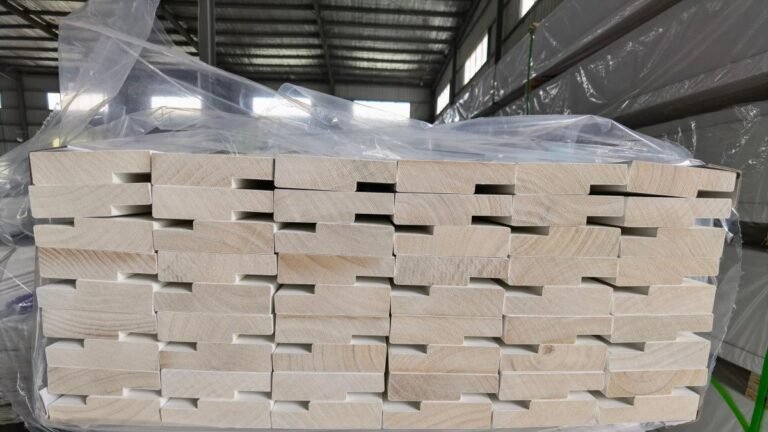
Goodwood Mouldings has made wood mouldings since 1995, and every stage of production, from log processing to finger-jointing, veneering, coating, CNC machining and packing, happens inside our own 200,000 m² manufacturing base. We load 20 to 60 SKUs into a single container. Mixed loading is also the step where shipping damage is most likely to start, so we treat it as an engineering process with written rules, not as a sales feature. This guide covers those rules, what happens to your moulding (also spelled molding in the US) at sea, and the cases where a mixed full-container order is the wrong choice.
What does "mixing 60 SKUs in one container" actually mean for an importer?
We accept orders from one full container (20ft or 40ft), and that container can carry anywhere from 20 to 60 different SKUs. We do not sell below one container. Within a container, you choose the mix of profiles, materials, lengths and finishes.
Industry-wide, importers and distributors rarely buy a container of one item. A typical pattern is to fill a container with dozens of SKUs so that stock covers a full range of baseboards, casings and trim, not just a few fast movers. That is a general purchasing habit, not something unique to us. It matters because it is why the mixed-load capability exists in the first place.
| Single-SKU full container | Mixed full container (20–60 SKUs) | |
|---|---|---|
| Best suited to | A few very high-volume items | A broad range stocked from one shipment |
| Inventory effect | Large quantity of few lines | Smaller quantity per line, wider range on the shelf |
| Packing complexity | Low | High: profiles differ in size, weight and material |
| Traceability need | One batch record | Separate batch record per SKU |
| Main shipping risk | Moisture across the whole load | Crushing, cross-contamination between materials, and moisture |
The right-hand column carries more risk. The sections below explain how we manage it. If you buy for a distribution network, our page for importers and distributors shows how this fits a typical stocking programme.
Why is a mixed container more likely to be damaged than a single-SKU load?
A mixed container carries more variables: more cross-sections, more weights, more materials and more pallets that touch each other. Any one of them can cause damage if the packing plan ignores it. In our experience, mixed loading is the stage most prone to quality incidents in the whole export chain.
Three things go wrong most often:
- Crushing. A slim, complex profile loaded under a heavy wide one can bend or deform under the weight of the stack.
- Material mismatch. MDF and solid wood differ in weight. Put together on one pallet, the heavier MDF can press on the lighter solid wood and distort it.
- Lost identity. With 40 SKUs in one box, a pallet that is not clearly labelled becomes very hard to inspect or trace after arrival. If you cannot tell which batch a damaged piece came from, nobody can find the cause.
None of these is exotic, and none requires special equipment to prevent. They require rules that are written down and followed every time.
How do we load 20–60 SKUs without crushing narrow profiles?
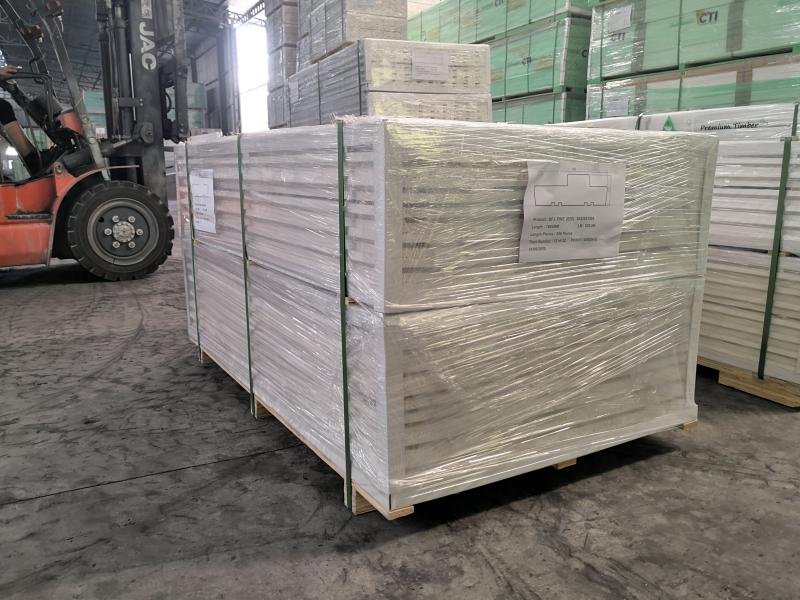
We separate profiles by cross-section in layers, keep MDF and solid wood on different pallets, and give every SKU its own batch number before it goes into the container. These are our own internal loading rules, not an industry standard. We set them because a mixed container fails where these rules are skipped.
Here is how the rules work in practice:
| Risk | What can happen | Our loading practice |
|---|---|---|
| Narrow or complex profiles under heavy stacks | Bending, edge damage | Different cross-section sizes are separated into layers so slim profiles are not loaded under heavy ones |
| MDF and solid wood on one pallet | Weight difference deforms the lighter material | MDF and solid wood are never mixed on the same pallet |
| Unlabelled mixed pallets | Cannot inspect or trace by SKU | Each SKU carries its own batch number and moisture record |
| Raw, unwrapped bundles | Surface moisture and scuffing in transit | Products are wrapped in fully sealed PE film, not shipped bare |
Pallet standardisation, private-label packaging, barcodes and colour labels are also available, which helps when your warehouse needs to pick and receive by SKU rather than by pallet.
Edge protection matters most for MDF. Cut ends of MDF take on moisture quickly, which is why we make end sealing a default for MDF mouldings shipped to humid destinations such as coastal Australia, a practice we adopted after a return shipment. We tell that story in full in What We Learned When an Importer's MDF Door Casing Swelled After Ocean Shipping, and the technical reasoning is in The Lesson From a Return Shipment: Why MDF Moulding Edges Must Be Sealed.
One honest limit: good loading reduces damage risk. It does not remove it. Ocean freight involves handling at ports, vibration and temperature swings that no packing plan can fully control.
What happens to moisture during 12–22 days at sea, and what do we do about it?
Sea transit from Xiamen takes roughly 12–15 days to Los Angeles and 18–22 days to Sydney, and during that time temperature swings can produce condensation inside the container, known as container rain1. The cargo is not sitting in a stable warehouse. It crosses tropical waters, and the day-night temperature difference inside a steel box is large. If you are importing into the United States or Australia, this voyage is part of your moisture planning, not just ours.
The mechanism is simple. Warm daytime air in the container holds moisture. When the box cools at night, that moisture condenses on cold surfaces, including the cargo and the container roof, and can drip onto the load. A moulding that left our factory at its target moisture content can arrive with a wet surface if it was packed without protection. We cover the full mechanism in What Happens to Your Wood Moulding During 12 Days at Sea.
Our response is in two parts. Before loading, we place desiccant1, such as lime bags or silica strips, inside the container. We also wrap product in fully sealed PE film rather than shipping it bare. Together they reduce how much moisture reaches the product during the voyage. They do not make cargo waterproof, and they cannot stop damage from an external leak or flooding. Sealed film is also not a cure-all: material that is already damp when wrapped can hold that moisture in, so moisture content at loading matters as much as the wrap itself.
What about the pallets themselves?
Export pallets bring a second moisture risk. International shipping of solid wood packaging to Australia, the US and the EU requires ISPM 15 treatment2. The common method is heat treatment, where the wood core reaches 56°C and holds for 30 minutes. In our production experience, heat-treated pallets can show a 2–4% rise in moisture content afterwards. If product is packed onto them while they are still damp, that moisture can transfer through contact surfaces into the bottom layer of mouldings.
Our internal rule is to leave heat-treated pallets to air for 72 hours, and to place PE isolation film between the bottom layer of moulding and the pallet. Again, this is our own standard, not a requirement of ISPM 15. For the compliance side of pallet treatment, read ISPM 15 Wood Packaging Compliance: The Detail Most Buyers Overlook.

How do batch numbers and records let you inspect a mixed container SKU by SKU?
Every SKU in a mixed container carries its own batch number and moisture record, so you can inspect, accept or reject lines one at a time, and we can trace any problem back to the production batch. That is the practical benefit of traceability: with 40 SKUs in one container, a problem in one line should not mean doubt over the other 39.
This sits on top of the three-stage quality control we run in the factory:
- IQC (incoming): each batch of timber or board is checked for moisture content, dimensions and appearance, and the record is tied to a batch number.
- IPQC (in process): key stations are sampled at regular intervals, covering items such as CNC accuracy, coating dry-film thickness and finger-joint gap.
- FQC (final): before shipment we sample to AQL 2.5 (ISO 2859-1)3, and any lot that fails is re-inspected in full.
These steps exist so that a SKU's records, from raw material to final check, can be pulled up when needed. We operate under an ISO 90014 quality management system, and batch-level records are how we apply it to mixed loading.
On arrival, you can use the same numbers to run your own receiving checks line by line. Each shipment is accompanied by the standard export documents: Commercial Invoice (CI), Packing List (PL) and Certificate of Origin (CO), which support smooth customs clearance. Which compliance certificates you need for your market depends on the products in the container. Our guide CARB, FSC, E0/E1 Explained: A Buyer's Guide to Wood Product Certifications walks through them, and our certifications page lists what we currently hold.
Material choice also shapes how a mixed load behaves. If you are deciding which materials to put in your mix, Solid Wood, Finger-Jointed, MDF or Veneered: How to Choose the Right Moulding sets out the trade-offs. If veneered mouldings are in the mix, read CARB Compliance for Veneered Moulding first.
When is a mixed full-container order not the right fit?
A full-container order is the wrong choice if you need less than one container, need delivery in under 21 days, or want one or two pieces of each profile as an experience order. Saying so up front saves both sides time.
| Your situation | Why it doesn't fit | What we'd suggest |
|---|---|---|
| Urgent restock of less than one container | Our minimum order is one full container, so small quantities are very costly per piece | A local distributor with stock on hand |
| Delivery needed in under 21 days | Production plus ocean freight takes at least 21–30 days at the fastest | A local stockist |
| One or two pieces of each of many profiles | Our production process is not set up to run mass-production routes for micro-quantities | Our sample support, which lets you assess profiles before you commit to a container |
Two more limits are worth naming. First, a mixed container shares one set of environmental conditions for 12–22 days, so SKUs with very different moisture sensitivity, for example interior MDF alongside solid wood, still need the separation and protection described above. Second, mixing many SKUs makes receiving more work for your warehouse team, because every line needs its own check. If your operation cannot handle SKU-level receiving, a simpler load may serve you better.
If your plan is a recurring range of 20 or more lines, shipped by container, for a market with defined moisture and compliance requirements, a mixed container is exactly what we built the process for.

Ready to plan your container?
Send us your target market, your draft SKU list and the materials you want in the mix. We will review it against the loading rules above and tell you how we would lay out the container, including which lines should travel on separate pallets. Plan your mixed-SKU container
Frequently Asked Questions
What is the minimum order quantity for wood moulding wholesale from Goodwood?
Our minimum order is one full container, either 20ft or 40ft. Within that container you can mix 20 to 60 SKUs. We do not supply quantities below one container. For small restocks, a local distributor holding stock is usually the faster and cheaper option.
Can MDF and solid wood moulding ship in the same container?
Yes, they can share a container, but never the same pallet. This is our internal loading rule: MDF is much heavier than solid wood and can deform it under pressure. MDF mouldings are also for dry interior use only, so we seal their cut ends when they ship to humid destinations.
Does a mixed container increase the risk of shipping damage?
Yes. More profiles, weights and materials in one box mean more ways for damage to happen. We reduce this with layered loading, separate pallets for MDF and solid wood, sealed PE wrapping, desiccant and per-SKU batch records. These steps lower the risk. They cannot remove it, because port handling and temperature swings at sea are outside any packer's control.
How can I check each SKU when the container arrives?
Every SKU carries its own batch number and moisture record, and each shipment includes a Packing List and Commercial Invoice. You can receive line by line against those documents. If one SKU has a problem, the batch number lets us trace it without questioning the rest of the container.
How long does it take to receive a mixed container order?
Production plus ocean freight takes at least 21–30 days at the fastest. Sea transit alone is roughly 12–15 days to Los Angeles and 18–22 days to Sydney. If you need goods in under 21 days, a local stockist is the better route.
For more questions about specifications and compliance documents, see our FAQ page.
Learn how condensation forms inside a sealed container, and what desiccants and plastic barriers can and cannot do. ↩
See the official ISPM 15 requirements for treating and marking wood packaging used in international trade. ↩
Read how ISO 2859-1 sets sampling plans for lot-by-lot inspection by acceptable quality limit. ↩
Find out what an ISO 9001 quality management system covers and what certification means. ↩