A batch can leave our Xiamen factory inside every moisture and dimension target and still arrive with damp packaging, a swollen end or a bowed piece. That is why we treat the voyage as part of production. After nearly three decades of making mouldings, and with mixed containers carrying 20–60 SKUs per load, we have learned that a container's journey needs its own controls, separate from the ones inside the factory.
A Xiamen–Los Angeles crossing takes roughly 12–15 days, and Sydney takes about 18–22. This article explains what happens to the cargo in that time, what we do before the doors close, and what packaging cannot fix.
What is "container rain," and why does it happen on long ocean routes?
Container rain is condensation that forms inside a closed shipping container when temperatures swing between day and night. Warm, humid air cools, can no longer hold its moisture, and water collects on cold surfaces and drips onto cargo. Long voyages across climate zones make these swings routine.
The mechanism is ordinary physics. During the day the sun heats the steel box and the air inside warms. At night the steel cools faster than the cargo, and the air touching it drops below its dew point1. Water then condenses on the roof and walls, and on cold cargo surfaces. On a voyage of 12 days or more, the cycle repeats many times.
Wood is hygroscopic2: it takes up and gives off moisture until it balances with the surrounding air. A carton sitting in a humid, condensing box is exposed to wet surfaces as well as damp air. Exposed cut ends, especially on MDF, are where moisture gets in fastest.
We treat this as something to prevent before loading. A wet container is hard to repair once it is at sea, and nobody can intervene mid-voyage.
If moisture content passed inspection at the factory, why does the voyage still matter?
A passing moisture reading at the factory tells you where the wood started. It says nothing about what happens afterwards. Condensation, damp pallets and humid dwell time at port are separate routes by which moisture can re-enter a batch that was in spec when it left.
Moisture control is our first line of defence, and the targets depend on where the goods are going. These are the targets we work to when shipping:
| Destination market | Shipping moisture content target | Basis |
|---|---|---|
| North America | 8–10% (±1%) | Heated interiors, low winter indoor humidity |
| Europe | 10–12% (±1%) | Maritime climate, higher indoor humidity |
| Australia (southern / coastal) | 10–12% (±1%) | Humid coastal conditions |
| Australia (Queensland and other hot, humid regions) | 12–14% (±1%) | Avoids over-drying for a humid climate |
For the final confirmation of an export batch we use the oven-dry method (AS/NZS 1080.1)3, the certification-grade, destructive test. For quicker checks on the line we use a pin-type resistance meter, which is accurate to about ±2% and suited to readings below 30% moisture content.
One related lesson from our own production: a moisture reading that is correct at the kiln exit is not enough. In thick stock, the core can run 3–5% wetter than the surface, which is why we allow a one-to-two-week equalisation period before machining. That topic has its own article: Moisture Content Passed Inspection — So Why Did It Still Warp?
Two honest limits apply here:
- Solid wood moves with humidity, and no packaging removes that. In heated North American homes, solid wood mouldings 90 mm or wider can change by 0.5–2.0 mm in width, depending on species, starting moisture and installation conditions.
- MDF mouldings are for dry interiors only. Even moisture-resistant (MR) grade MDF can suffer irreversible internal damage under rain exposure or sustained high humidity. It has less tolerance for a damp voyage than solid wood does. For Australia-bound MDF, our internal rule is that both cut ends receive end-sealer before shipment. That is our own rule, not an industry requirement. We explain how it came about in The Lesson From a Return Shipment: Why MDF Moulding Edges Must Be Sealed.
How do we pack and load a container to reduce moisture and damage risk?
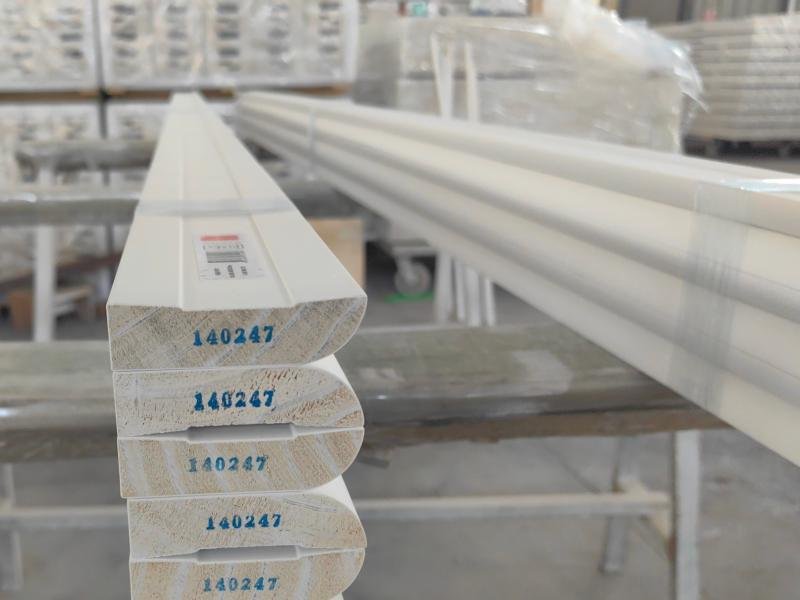
We reduce risk with four things: moisture barriers around each pack, desiccant in the container, controlled pallet preparation, and load plans that stop products damaging each other. None of these is an industry standard that we are quoting. They are our own procedures, built from what we have seen go wrong.
| Risk in transit | What we do (internal procedure) |
|---|---|
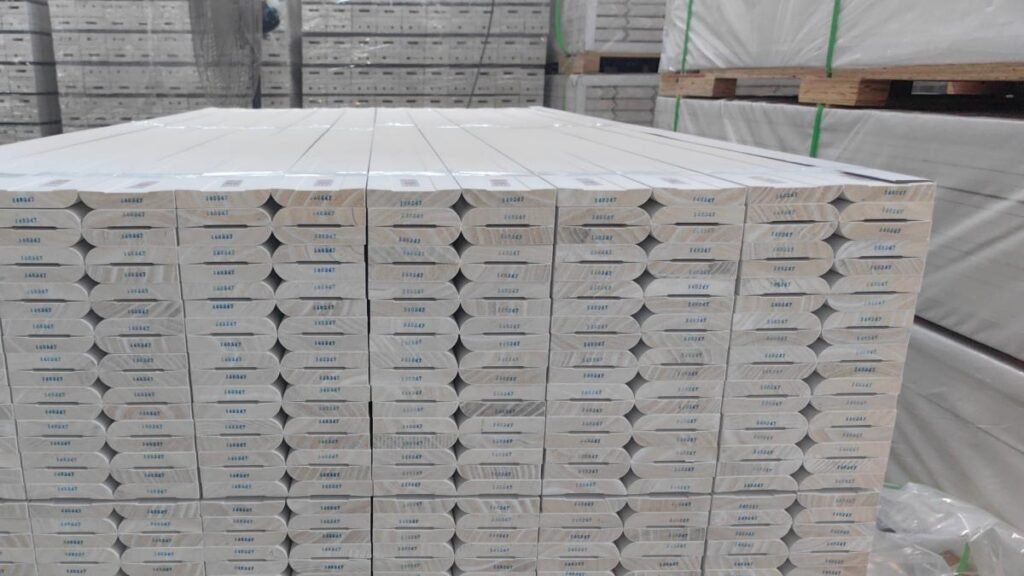
| Container rain and humid air | Desiccant (lime bags or silica strips) placed in the container before closing. Product packed in fully sealed PE film, never bare. |
| Moisture from the pallet | After heat treatment, pallets are left to dry for 72 hours before product is packed on them. A PE barrier film separates the bottom layer from the pallet. |
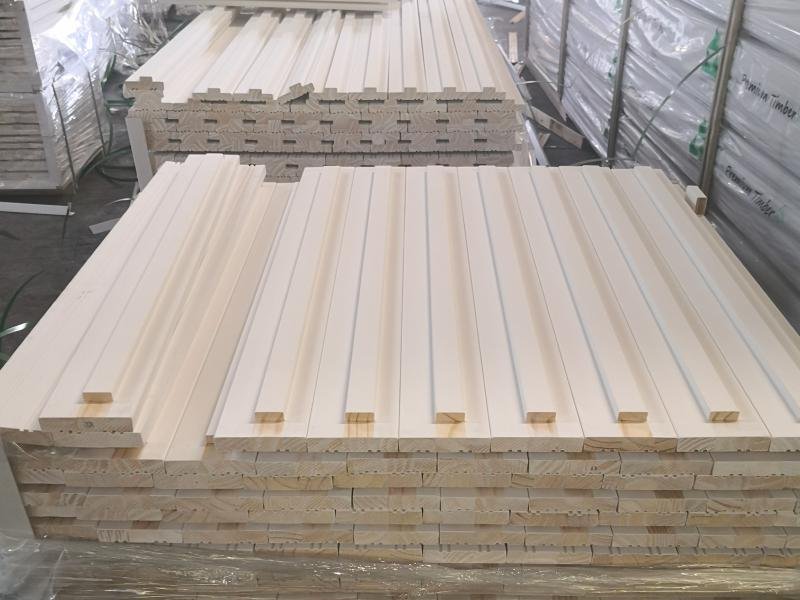
| Mixed loads damaging each other | Different profile sizes are separated in layers so heavy stock does not press on slim or complex profiles. MDF and solid wood are never placed on the same pallet. |
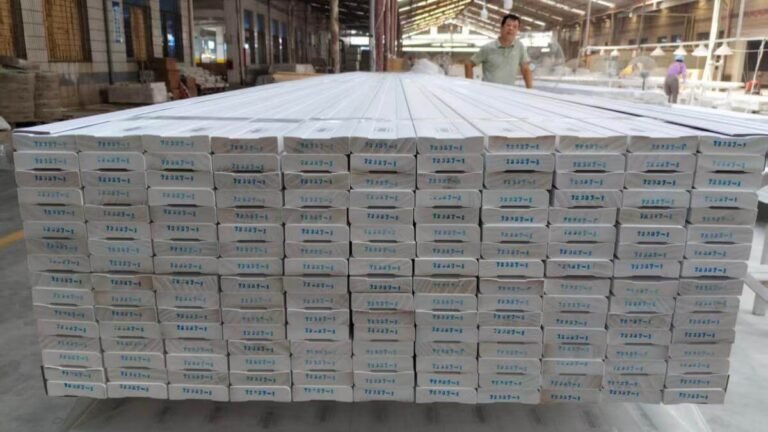
| Hard-to-trace problems on arrival | Every SKU carries its own batch number and moisture record, so a problem can be traced to a specific batch. |
The pallet step deserves a closer look because it is easy to miss. Heat treatment of wooden pallets can raise their moisture content by 2–4%. If product is packed onto a pallet that has not dried out, that moisture is passed to the bottom layer through contact. Container-packing guidance makes the same general point: keep the water content of cargo, packaging and the container floor low4. Sealed film cuts exposure from the outside, but it can also hold in moisture that is already inside the pack, which is one more reason the drying step matters. We learned to leave the pallet for 72 hours and add a PE film between pallet and product. Pallets used in international shipping fall under ISPM 155, the international standard for wood packaging material; we cover the compliance details in ISPM 15 Wood Packaging Compliance: The Detail Most Buyers Overlook.
Mixed loading is where most transit damage risk sits. When one container carries 20 to 60 SKUs, you have different lengths, weights and profile shapes sharing one box. MDF is considerably heavier than solid wood, so mixing them on one pallet risks compressing the MDF. Slim, complex profiles are the first to suffer if heavy stock is stacked on top. Keeping the loading plan by layer and by material is a planning discipline, not an afterthought. The wider approach is covered in Mixing 60 SKUs in One Container: How We Control Shipping Damage Risk.
Batch management and traceability are part of our quality control system. In practice, that means if one SKU has a problem on arrival, we can tell whether the issue is that batch or something that happened to the container as a whole.
What can't packaging fix, and what should you check when the container arrives?
Packaging reduces moisture risk but does not remove it. If a container sits in port for long periods, if a door seal is damaged, or if cargo is unloaded in rain, sealed film can only do so much. And if the wood is not in spec before loading, no desiccant will correct it. What we can do is cut the common risks and make problems traceable.
Here is what we suggest you check on arrival, whoever your supplier is:
- Look at the outer packaging first. Are there signs of condensation on the PE film, water marks on cartons, or damp pallet boards? Photograph these before unpacking, with the container number visible.
- Match batch numbers and moisture records. Compare what is on the pallets with the batch documentation. This tells you which batch to look at if something is wrong.
- Spot-check moisture with a meter, on several pieces across several pallets. A pin-type meter is quick and suits unfinished stock. For primed or finished product, a non-destructive capacitance-type meter avoids pin marks on the surface. Both are only accurate to about ±2%, so a one-point difference from the shipping record is not a defect. A gap of several points deserves a conversation.
- Check cut ends on MDF and veneered pieces. Exposed ends are where swelling shows up first.
We would rather you check promptly than discover a problem three months later in an installed building, when it is much harder to say what caused it.
One further point. If your project needs a fast replenishment of a single SKU in small quantities, a local stockist is faster than any ocean freight route. We ship full containers, and the transit time is part of the plan.
Planning a mixed container? Send us your SKU list and destination, and we will talk through moisture targets for your climate, loading layout by material and layer, and what to check on arrival. Plan your mixed-SKU container
Frequently asked questions
What is container rain, and can it damage wood moulding?
Container rain is condensation that forms inside a closed container when the air cools below its dew point and water drips from the roof and walls onto cargo. It can wet packaging, pallets and exposed cut faces. We reduce the risk with desiccant and sealed PE packaging, but no packaging removes it completely.
If a batch passes moisture inspection at the factory, will it arrive in spec?
Not automatically. A factory reading shows where the wood started. Condensation, a damp pallet or humid dwell time can add moisture afterwards. That is why we control pallet preparation and packing as well as kiln moisture, and why every SKU carries its own batch number and moisture record.
Is MDF moulding suitable for ocean freight to humid destinations?
MDF moulding is for dry interiors only, and even moisture-resistant grades can be permanently damaged by rain or sustained high humidity. It can be shipped with protection, and for Australia-bound orders we seal both cut ends as an internal rule. But it has less tolerance for a damp voyage than solid wood.
Can solid wood moulding be made immune to humidity changes?
No. Solid wood moves with humidity, which is a physical property, not a defect. Mouldings 90 mm or wider can change by 0.5–2.0 mm in heated North American homes, depending on species, starting moisture and installation conditions. Correct shipping moisture targets reduce movement; they do not eliminate it.
Can I order a small quantity of one SKU for fast delivery?
Our minimum order is a full container, and production plus ocean freight takes 21–30 days at the fastest. For small, urgent top-ups, a local stockist is the better choice.
Related reading: Mixing 60 SKUs in One Container: How We Control Shipping Damage Risk
See how condensation forms inside a closed container when air cools below its dew point, and why it can drip onto cargo. ↩
Learn how wood exchanges moisture with the surrounding air and why that changes its dimensions. ↩
Explore how the oven-dry method determines timber moisture content and how resistance and capacitance meters are used to estimate it. ↩
See the container-packing guidance on limiting condensation by keeping cargo, packaging and the container floor dry. ↩
Find out what ISPM 15 requires for wood packaging material used in international trade. ↩