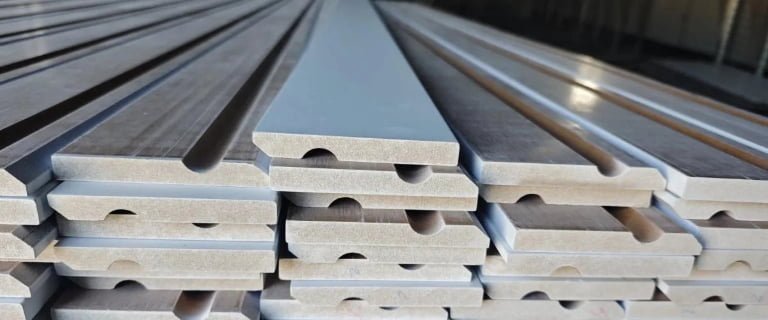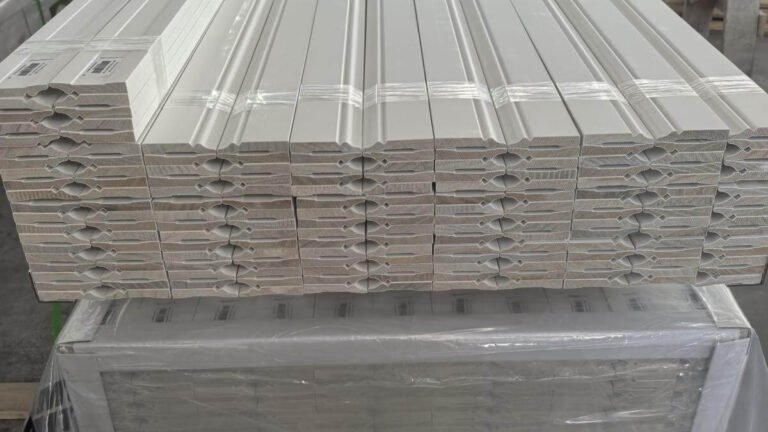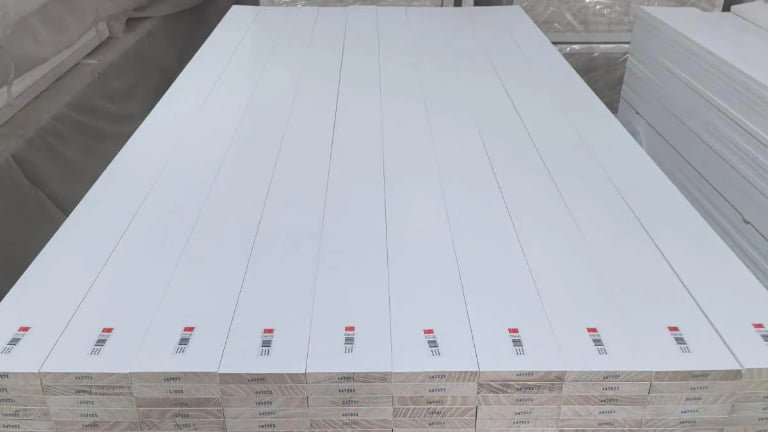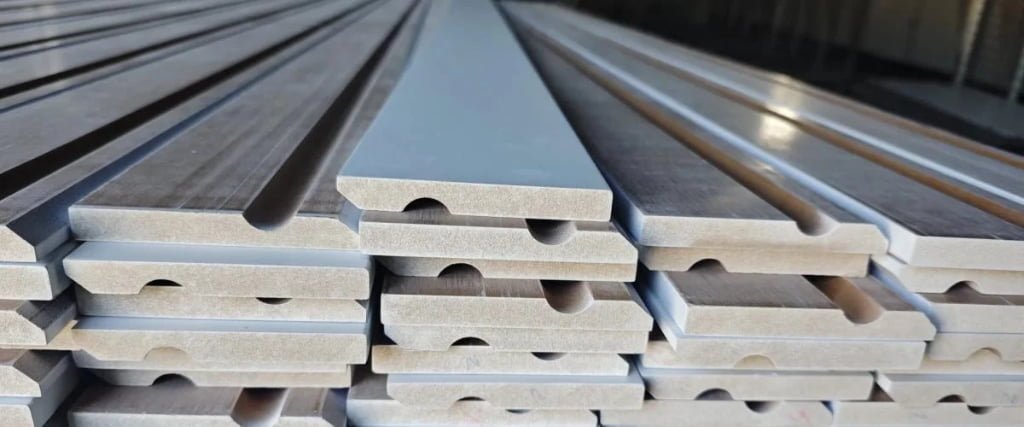
Every mixed-SKU order we ship out of our 200,000 m² facility includes at least one line item where a buyer has asked us to swap high-density MDF for standard density "to bring the price down." Sometimes that's the right call. Sometimes it quietly moves the cost somewhere else — finishing labor, coating waste, rework — where it's harder to see on a quote sheet. After nearly three decades running MDF moulding through our own shop floor, here's what we've actually found when we track the full cost, not just the material line.
Is high-density MDF moulding actually more expensive to buy?
Yes, at the material level — high-density MDF (800–860 kg/m³) typically carries a 12–18% cost premium over standard-density MDF (700–750 kg/m³). That part of the quote is not in dispute. What the unit price doesn't show is what happens downstream, once that board actually goes through routing, sanding, and coating.
Standard-density MDF and high-density MDF behave differently the moment a router bit touches them, and that difference shows up in labor and material consumption long before the product reaches a customer's warehouse.
| Parameter | Standard density (700–750 kg/m³) | High density (800–860 kg/m³) |
|---|---|---|
| Material cost | Lower baseline | +12–18% vs. standard |
| Routed edge quality | Slight fuzzing/burring on profile edges | Crisp, clean edge definition |
| Primer/coating absorption | 15–20% higher uptake than high density | More even, lower uptake |
| Sanding passes typically needed | Standard | 1–2 fewer passes on complex profiles |
| Best suited for | Wide, flat mouldings; simple profiles | Complex/fine profiles (multi-curve, sharp detail) |
We build this table into every internal quote review, because a buyer comparing two line items side by side almost never sees the "1–2 fewer sanding passes" row — only the per-meter material cost.
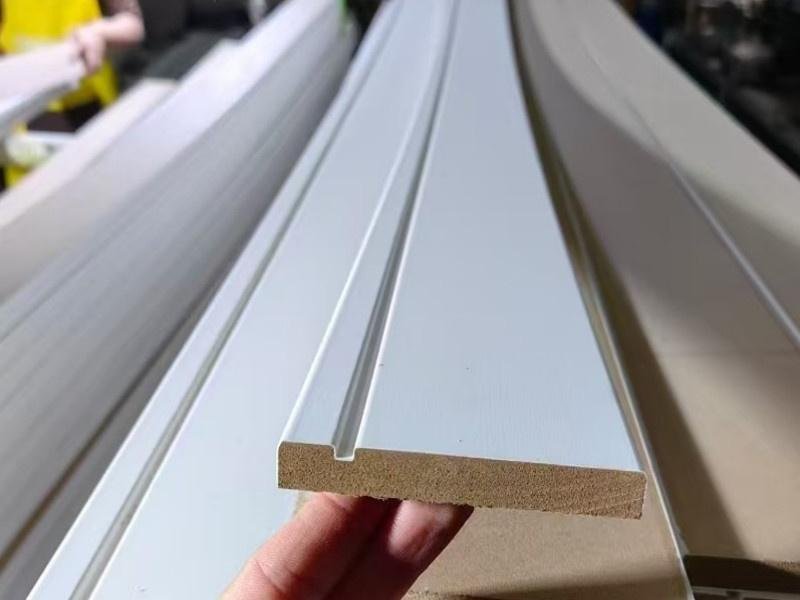
Why can complex profiles cost less overall with high-density MDF?
For complex, multi-curve profiles, the labor and coating savings from high-density MDF can fully offset — or in some cases exceed — the material premium, making the total per-piece cost comparable to or lower than standard density.
Here's the mechanism, as we see it on our own line. Standard-density MDF has a slightly softer, more open surface at the cut edge. On a wide, flat baseboard that's rarely a problem — one clean sanding pass and a primer coat handle it fine. But run that same standard-density board through a router cutting a detailed, multi-radius profile, and the edge fuzzing shows up at every curve and transition, not just on a flat face. That means:
- An extra sanding pass (sometimes two) just to knock down the fuzz before primer will hold
- Higher primer absorption — 15–20% more, by our own production figures — because the softer surface pulls in more coating material per pass
- A higher chance the profile needs to be re-touched before it passes final inspection
High-density board, by contrast, routs cleaner from the first pass. The sharper cell structure holds a crisp edge through tight curves, absorbs primer more evenly, and in our experience typically needs one to two fewer finishing passes on genuinely complex profiles. Once you price in the labor-hours and coating volume saved, the 12–18% material premium narrows — and on our more intricate profile runs, it's been fully absorbed by the finishing savings alone.
This is not a claim that high-density MDF is "cheaper" in the abstract. It's a claim that the material premium and the finishing savings pull against each other, and which one wins depends entirely on how complex the profile is.
When does standard-density MDF remain the smarter choice?
For wide, flat mouldings and simple profiles, standard-density MDF remains the more economical option — the finishing-cost offset that applies to complex profiles doesn't materialize on simple geometry, so there's no reason to pay the high-density premium.
If a profile is essentially a flat or gently curved face — a plain baseboard, a simple cove — there aren't enough tight radii or fine detail points for the edge-quality advantage of high-density board to translate into fewer sanding passes. You're routing largely straight or broadly curved surfaces, where standard density handles the job without the fuzzing issues that show up on intricate detail. In that scenario, paying 12–18% more for material properties you're not actually using is simply added cost with no offsetting return.
We tell buyers this directly when they ask us to "just use the good stuff" across an entire order: it's not that high-density is universally better, it's that the cost logic only flips in your favor once the profile complexity crosses a certain threshold.
One point worth being upfront about regardless of density: MDF moulding — standard or high-density — is suited to interior, dry-environment applications only. MDF's density (700–860 kg/m³) is meaningfully higher than solid wood (roughly 420–650 kg/m³), and large-section MDF door casings can run 30–50% heavier than an equivalent solid wood profile — a factor worth accounting for in shipping weight calculations and wall-mounting specifications, separate from the moisture question. We go into what that means for edge protection and humid-climate shipping in more detail in our MDF edge-sealing guide. For this article, the takeaway is simply that density selection is a finishing-cost and edge-quality decision first, not a moisture-resistance decision.
How should you decide which density to request for your next order?
Match density to profile complexity first, then to your finishing budget — request high-density MDF for detailed, multi-curve profiles where edge quality drives rework, and standard density for wide or simple profiles where the premium buys you nothing measurable.

In practice, most of our distributor and importer partners aren't ordering a single profile — they're filling a container with a mix of SKUs, and that's exactly where this decision matters most. A mixed-SKU shipment might reasonably combine standard-density board for a run of wide baseboards with high-density board for a set of fine crown moulding profiles in the same load, because each SKU is priced and specified on its own finishing economics rather than a blanket density rule applied across the whole order.
That's the level of detail we work through on a SKU-by-SKU basis when a distributor is planning a mixed container — not just what profile shapes go in, but what density makes sense for each one, so the finishing cost is optimized across the whole shipment rather than defaulted to one density for everything.
If you're still weighing MDF against solid wood, finger-jointed, or veneered options for this project, see our full moulding material comparison guide.
Plan your mixed-SKU container — talk to us about matching density specifications to each profile in your next order.
Frequently Asked Questions
Is high-density MDF moulding always better quality than standard density?
Not necessarily "better" — it's suited to different jobs. High-density MDF gives cleaner routed edges and more even coating absorption, which matters most on complex, multi-curve profiles. On wide, flat mouldings, standard-density MDF performs just as well and costs less, so higher density isn't a universal upgrade.
Why does high-density MDF cost 12–18% more per meter?
The premium reflects the raw material itself — high-density MDF (800–860 kg/m³) requires more fiber and resin per board than standard-density MDF (700–750 kg/m³) to achieve its denser structure, which is priced into the base material cost before any finishing work happens.
Does choosing high-density MDF mean fewer defects or less rework?
On complex profiles, yes — the crisper edge definition typically reduces sanding passes and lowers the chance a profile needs re-touching before final inspection. On simple, wide profiles, the defect rate difference between densities is minimal, so the rework savings don't apply in the same way.
Can I mix standard-density and high-density MDF profiles in the same container order?
Yes — this is common practice for mixed-SKU shipments. Density is typically specified per profile based on its complexity, not applied uniformly across an entire order, so a single container can reasonably include both standard-density wide baseboards and high-density detailed profiles.
Is high-density MDF moisture-resistant?
No — density and moisture resistance are separate properties. Both standard and high-density MDF are intended for interior, dry-environment use; neither is suited to outdoor or persistently humid conditions regardless of density.