Some frame problems never show up at the factory gate. They appear eighteen months later, on someone else's production line or building site. Goodwood Mouldings (also spelled molding in the US) has been making wood mouldings and door frame components in Xiamen since 2008. Finger-jointing, machining, finishing and packing all happen inside our own factory. That means when a joint moves, we cannot point to a subcontractor. This is the story of one such case, what it changed in our door frame line, and the questions it taught us to put on the table before an order, not after a complaint.
What did the door manufacturer report?
A door manufacturer reported that the finger joints in our PVA-bonded frame profiles had shifted by 0.5–1.0mm after about 18 months in service. The frames were hanging solid oak doors weighing roughly 55kg. The movement was small in absolute terms, but a joint in a door frame is supposed to stay exactly where it was glued, and any measurable shift is a warning sign.
The profile was a finger-jointed frame section made to our standard specification at the time: PVA adhesive and a 12mm finger length. The door manufacturer had matched it to a heavy solid oak door, a combination our specification had never explicitly ruled out. We had not told the customer where the limit was.
That last point matters most in this story, and we return to it below.
Why did the joints move after 18 months?
The joints crept under repeated shear load. A door that opens and closes repeatedly sends small vibrations and shear stress through the frame. With a door of roughly 55kg, a PVA-bonded joint with 12mm fingers slowly deformed under that repeated load. Over 18 months it accumulated into a visible displacement of 0.5–1.0mm.
Two details from the review are worth recording:
- The failure was gradual. The movement appeared only after long service under load, which is exactly why it is hard to catch in a factory check.
- It was a mismatch between specification and application. Our technical data sheet now recommends PVA-bonded profiles only for doors up to 30kg, and this frame was carrying a door of roughly 55kg. The root cause was a missing limit, not a random production slip.
We deliberately keep the adhesive chemistry out of this article. If you want the technical comparison, read our PVA or PUR guide for door frame mouldings. Here we stay with what we found and what we did.
What did we change after the complaint?
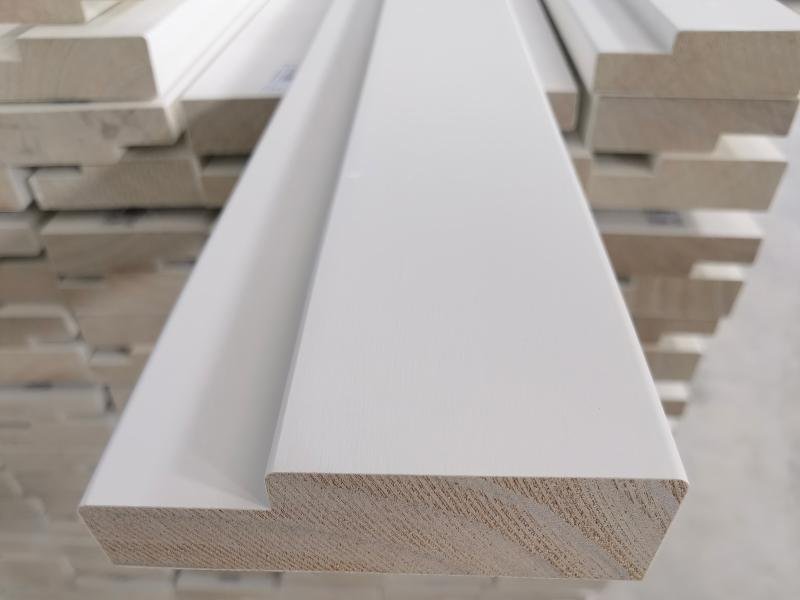
We moved the whole door frame line to PUR adhesive, lengthened the fingers from 12mm to 22mm, and wrote the load limit for PVA profiles into our technical data sheet (TDS). We addressed both the adhesive and the joint geometry, and we added the missing information so no customer has to find the limit by trial.
| Item | Before | After |
|---|---|---|
| Adhesive on door frame profiles | PVA | PUR |
| Finger length | 12mm | 22mm |
| Load guidance in the TDS | No explicit limit for PVA finger-jointed profiles | Recommended for door weights up to 30kg, stated explicitly |
One point needs to be clear. Using PUR on every door frame SKU is our own internal rule. It is not an industry standard requirement. Standards do not force a supplier to choose PUR for a door frame, and some suppliers still use PVA for these parts. We chose to make PUR the default for door frames because this case showed us what the alternative costs a customer. Because finger-jointing, machining and finishing are all done in our own plant, the change applied to the whole door frame line rather than to one order.
The change is now part of our normal door frame process. It is not a one-off fix for one customer.
What should you ask any frame supplier about finger joints?
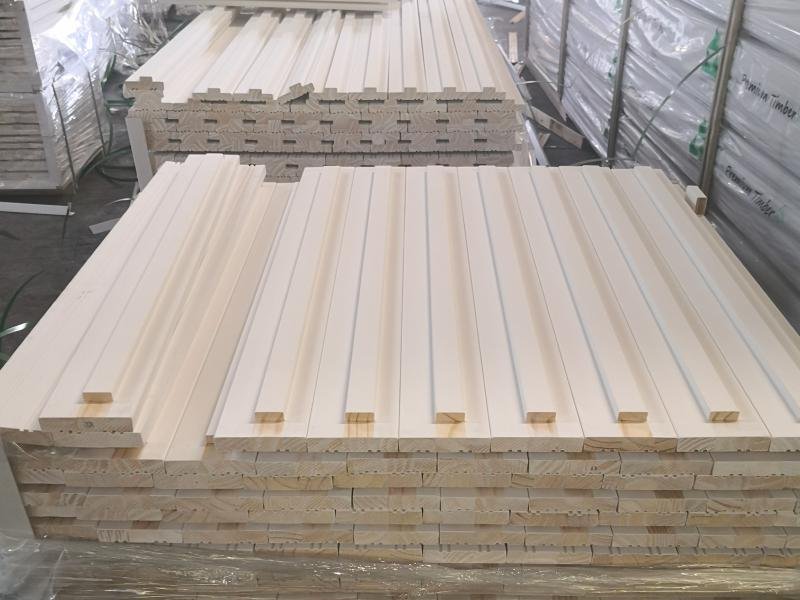
Ask four questions before you place an order: which adhesive is at the joint, how long the fingers are, what door weight the frame is designed for, and where that limit is written down. Any supplier, including us, should be able to answer all four from a document, not from memory.
- Which adhesive is used at the finger joint: PVA or PUR? The answer should come in writing, per SKU, not as a general statement about the factory.
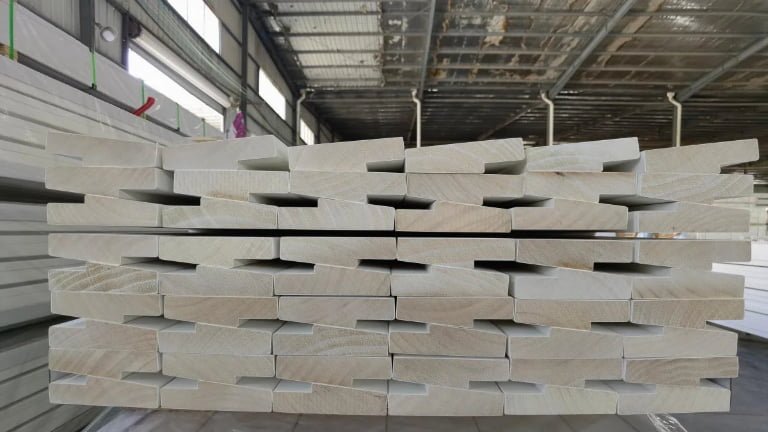
- What is the finger length? Finger-jointing is used in both structural products and mouldings and trim, and public forestry guidance notes that structural joints are cut with deeper fingers than non-structural ones1. The finger length on the specification tells you which job the joint was designed for.
- What door weight is the frame designed for? If the supplier cannot name a figure, the frame has not been specified for your door.
- Is that limit written in the TDS? This is the lesson we took from this case: the limit belongs in the specification sheet, not in a reply after a complaint.
A few honest limits belong here as well:
- PVA-bonded finger-jointed profiles are not suited to structural frames carrying heavy doors. For structural applications, PUR-bonded profiles are required and should be requested explicitly.
- Finger-jointed mouldings, whatever the adhesive, are suited to paint-grade finishes. The joints can show under clear or semi-transparent coatings. That is a structural characteristic of the product, not a manufacturer's workmanship issue, and it applies to every supplier.
We would rather have these limits in front of you before you buy than learn them from a loosened joint eighteen months later.
What should a door frame specification sheet state, field by field?
A door frame specification sheet should state five things for each SKU: the adhesive at the finger joint, the finger length, the recommended door weight, the intended application, and the finish it is suited to. If any of the five is missing, you are left guessing at the one you cannot see. We would apply the same checklist to our own sheets.
| Field | What it should say | Why it mattered in this case |
|---|---|---|
| Adhesive at the finger joint | PVA or PUR, stated per SKU | The original profile was PVA-bonded, and the adhesive set the ceiling on which doors it suited |
| Finger length | A figure in millimetres | 12mm on the original profile, 22mm on our current door frame line |
| Recommended door weight | A maximum, in kilograms | The door was roughly 55kg; our PVA recommendation is up to 30kg |
| Intended application | Structural door frame, or decorative trim | PVA-bonded finger-jointed profiles are not suited to structural frames carrying heavy doors |
| Finish suitability | Paint-grade, or another finish | Finger joints can show under clear or semi-transparent coatings |
Per SKU matters because a single factory can use different adhesives on different parts. A general statement about the factory tells you little about the frame you are buying. A sheet that lists only a profile drawing and a material describes the shape of the part, not what the part can carry.
If your door is heavier than the stated limit, do not assume the frame will cope. Ask the supplier which specification they recommend for that weight, and ask for the answer in writing. For a door of roughly 55kg, the answer our case led us to is a PUR-bonded frame.
Frequently asked questions
Are PVA-bonded finger-jointed door frames suitable for every door?
No. In our technical data sheet, PVA-bonded finger-jointed profiles are recommended for door weights up to 30kg. The frames in this case were hanging a door of roughly 55kg. For heavy solid doors we specify PUR-bonded frames.
If a finger joint passes factory inspection, will it hold for the life of the door?
Not automatically. In this case the movement appeared only after about 18 months of repeated opening and closing under a heavy door. That is why we now ask for the door weight and write the load limit into the TDS, rather than relying on inspection alone.
Is a longer finger length enough to fix a loosening joint?
We would not treat it as a single fix. In this case we changed the adhesive, the finger length and the documentation together: PVA to PUR, 12mm to 22mm, and an explicit load limit in the TDS. Treat them as a package when you review a supplier's frame specification.
Can finger-jointed door frames be used under a clear finish?
Not if you need an invisible joint line. Finger joints can show under clear or semi-transparent coatings, whichever supplier makes them. Finger-jointed mouldings are suited to paint-grade finishes.
Where do I find the load limit for a frame profile?
It should be in the supplier's technical data sheet for that specific SKU. If it is not there, ask the supplier to confirm the adhesive, finger length and maximum recommended door weight in writing before you order.
Ask about PUR-bonded door frame specs
If you are specifying finger-jointed frames for a solid or heavy door, send us your door weight and frame profile drawing. We will go through the adhesive, finger length and TDS load guidance for that frame with you before you commit to an order.
Ask about PUR-bonded door frame specs · See our door and window components · Finger-jointed mouldings
Still deciding between materials? Our guide to choosing between solid wood, finger-jointed, MDF and veneered mouldings compares all four, including the limits of each.
See how Canada's forestry service explains where structural and non-structural finger joints differ. ↩