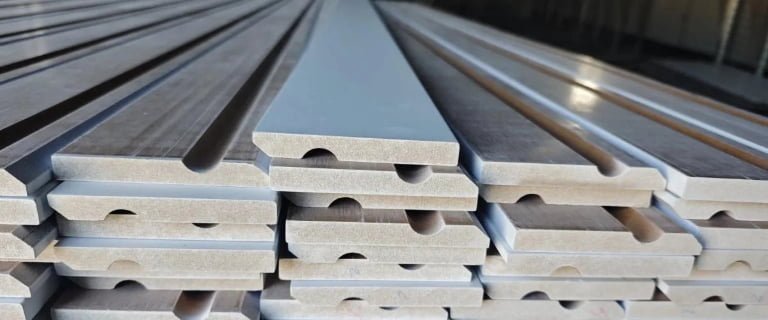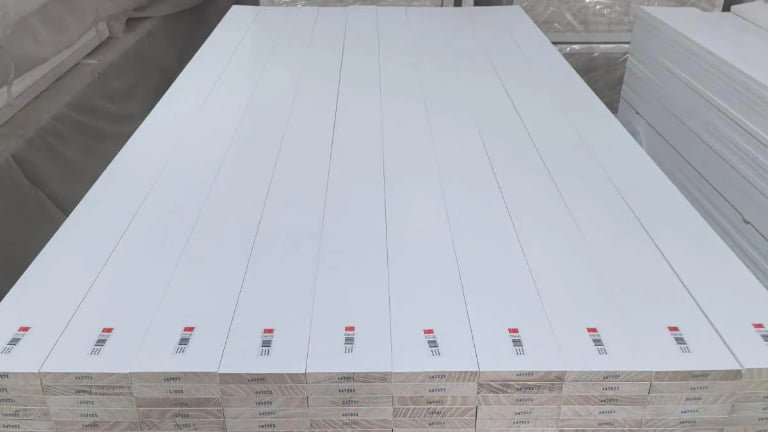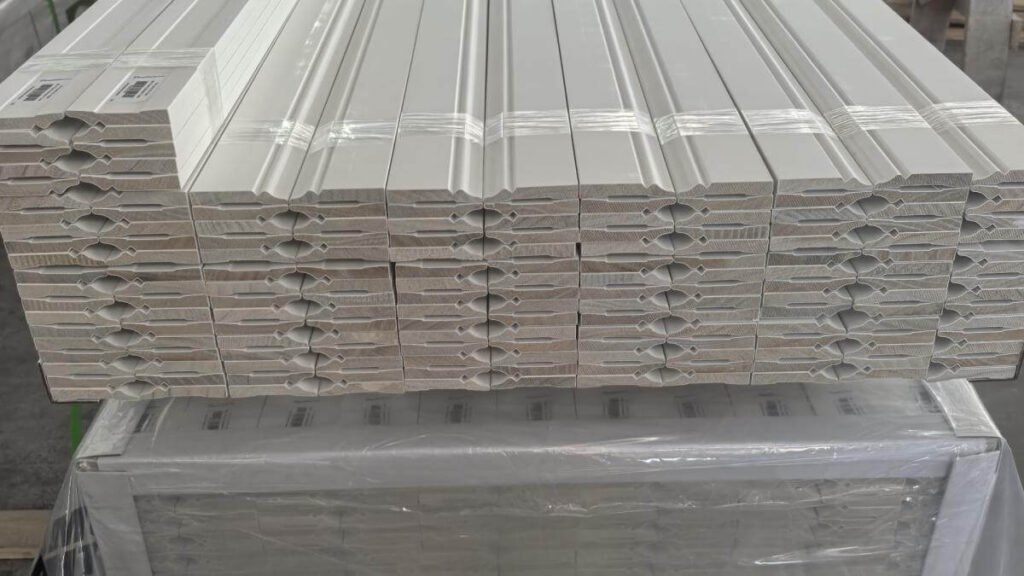
Finger-jointed door frame moulding (also spelled molding in the US) has been a core part of our production for nearly three decades, and one thing we've learned from running that process in-house — from timber selection through finger-jointing, milling, and finishing — is that the adhesive decision is not a back-of-house detail. It's a specification question, and it belongs in your purchase order, not left to a factory's default settings.
Most buyers know that finger-jointed moulding uses adhesive1 to bond short lengths of timber into a continuous piece. Fewer buyers ask which adhesive, and fewer still specify it. That gap is where structural door frame problems start — not at installation, but years later.
What's actually different between PVA and PUR adhesive in finger-jointed moulding?
The short answer: PVA (polyvinyl acetate) is lower-cost and performs well in dry, low-load applications, but its strength drops noticeably when exposed to moisture over time. PUR (polyurethane reactive hot-melt) costs 30–50% more, cures irreversibly2, and retains over 90% of its strength even under humid, load-bearing conditions.
| Adhesive | Cost | Dry-State Strength | Wet-State Performance | Suitable For |
|---|---|---|---|---|
| PVA (polyvinyl acetate) | Lower | 80–90% of solid wood strength | Strength drops noticeably after moisture exposure | Interior decorative-only moulding (baseboard, chair rail, decorative door casing) |
| PUR (polyurethane reactive) | 30–50% higher | Cures irreversibly | Retains 90%+ strength in wet-state conditions | Door frames, split jambs, and other structural, load-bearing profiles |
The distinction isn't marketing language — it reflects how each adhesive chemistry behaves under sustained mechanical stress, not just a single lab test. PVA is a cold-setting adhesive that never fully cross-links; PUR cures into a permanent, moisture-resistant bond. For purely decorative trim that never carries weight, that difference rarely matters. For a door frame carrying a swinging door for years, it does.
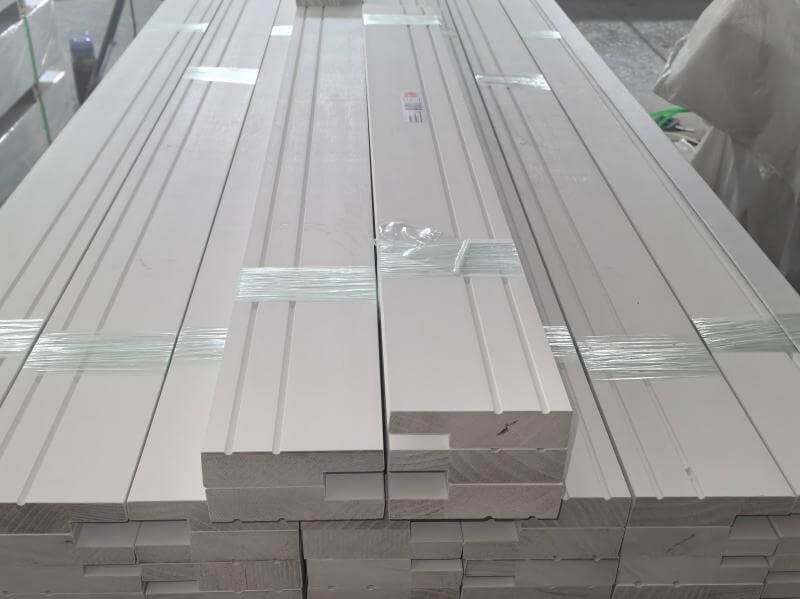
Why does a PVA-jointed door frame work fine for years — then suddenly fail?
The short answer: PVA finger joints don't fail on day one. They degrade gradually under repeated opening-and-closing loads, and by the time a shift becomes visible, the joint has already been creeping for months or years.
This is a pattern we've seen directly. In one case, a finger-jointed window/door frame profile — bonded with PVA, 12mm finger length — was used to hang a solid oak door. The door's weight was approximately 55kg. The frame held for months with no visible issue. Then, over roughly 18 months of repeated opening and closing, the PVA joint experienced shear creep from the repeated swing load, eventually producing a measurable 0.5–1.0mm displacement at the joint.
Nothing about the installation was wrong. The frame looked fine at handover and passed initial inspection. The failure mode is inherent to the adhesive chemistry under sustained cyclic load — not a workmanship defect, which is exactly why it's easy to miss at the specification stage.
Where things stand more broadly: this isn't unique to any one supplier. Across the industry, it's common for door frame products to be finger-jointed with PVA by default, since PVA is cheaper and performs adequately in short-term testing. The risk shows up specifically when that frame supports a heavy door — industry experience suggests shear risk within 3–5 years for PVA-jointed frames supporting doors over roughly 40kg. The joint isn't obviously wrong until it's already moving.
(We cover the full story behind this case — including how the customer first noticed it and what changed afterward — in a separate case study, linked once published.)
How much weight can a PVA finger joint actually hold?
The short answer: There isn't one universal number — the safe threshold depends on who's setting it and how conservatively. Our own product documentation recommends limiting PVA finger-jointed frames to doors of 30kg or less, while the broader failure-mode profile for PVA joints under structural load applies more generally to solid-core doors above roughly 35kg.
We want to be transparent about why there are two different figures here rather than picking whichever sounds better:
- The 30kg recommendation comes from the corrective action we took after the case above — we deliberately set the guidance conservatively, below the point where we'd observed failure, and now document it directly in our technical data sheets (TDS) so the limitation is stated upfront rather than discovered after installation.
- The 35kg threshold reflects the general point at which PVA-jointed structural applications move from "acceptable" to "not recommended" as a category, independent of any single case.
Either way, the underlying message is the same: PVA finger joints are not rated for indefinite structural load, and that rating needs to be written into the spec, not assumed. If your project involves solid-core doors — oak, maple, or other dense hardwoods — that weight range deserves a direct conversation with your supplier before production starts, not after.
When is PUR the only right choice for structural door frame applications?
The short answer: Any door frame, split jamb, or load-bearing profile that will carry a heavy or solid-core door should specify PUR adhesive with a longer finger-joint length — not PVA, regardless of cost savings.
Finger-joint geometry matters here too, not just the adhesive itself. Decorative-grade joints and structural-grade joints are cut differently:
| Joint Grade | Finger Pitch | Finger Length | Recommended Adhesive |
|---|---|---|---|
| Decorative grade | 8–12mm | 8–12mm | PVA acceptable (non-load-bearing) |
| Structural grade (door frames / load-bearing) | ≥20mm | ≥20mm | PUR required |
A longer, deeper finger joint distributes stress across more surface area — which is exactly why, after the case described above, we increased the finger length on that product line from 12mm to 22mm alongside switching to PUR. Longer fingers alone don't solve a PVA moisture problem, but combined with PUR they materially change how the joint handles cyclic load.
We should be clear about what's a rule here and what's an industry norm. Requiring PUR on every door frame SKU we produce is our own internal specification — it is not a mandatory industry-wide standard, and other manufacturers may reasonably use PVA for lighter-duty frame applications. We set this requirement after direct production experience with the failure mode described above, and it now applies across our door frame and split-jamb product lines by default.
One more detail worth knowing before you spec anything: finger joints should never land on a knot position. A knot at the joint location can reduce tensile strength at that joint by 40–60%, regardless of which adhesive is used. It's a small detail on a drawing, but it matters more than the adhesive choice in some failure cases.
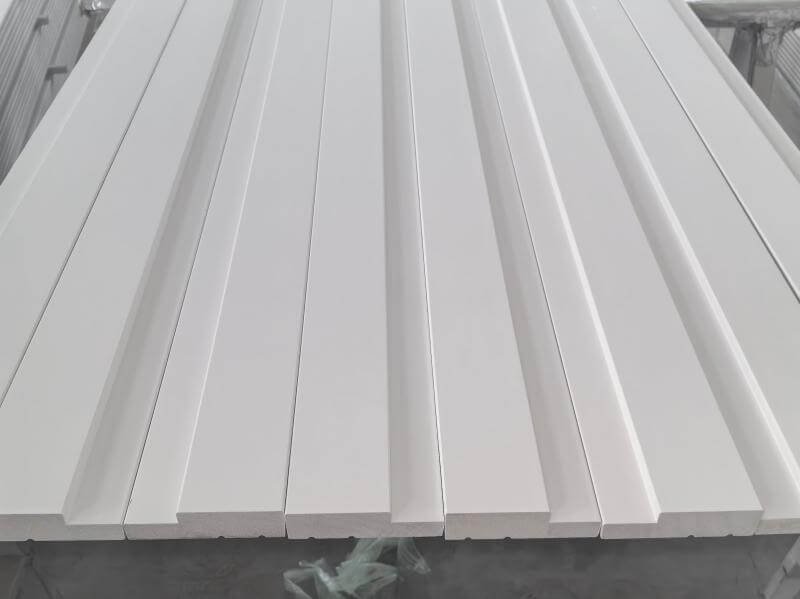
What should you ask your moulding supplier before specifying adhesive type?
The short answer: Ask what adhesive is used by default on structural profiles, what the tested weight threshold is, and whether that limit is documented in writing — not just described verbally.
If you're sourcing finger-jointed door frame moulding, three questions are worth putting directly to your supplier:
- Is PVA or PUR used by default on door frame and structural SKUs? If the answer is "PVA unless otherwise specified," ask what the expected door weight range is for your project.
- What's the documented weight threshold, and is it in the TDS? A verbal assurance isn't the same as a written specification your installer and architect can reference later.
- What's the finger-joint geometry? Structural-grade joints (≥20mm pitch and length) behave differently from decorative-grade joints (8–12mm), independent of adhesive.
It's also worth being upfront about what finger-jointed moulding can't do, regardless of adhesive choice: finger joints are visible under clear or semi-transparent (stain-grade) finishes, no matter how precise the cut. This is a structural characteristic of the product itself, not a workmanship limitation — any finger-jointed profile from any manufacturer will show this. If your project requires a fully seamless, stain-grade appearance, a finger-jointed frame — PVA or PUR — isn't the right product category; solid, unjointed timber is a better fit for that specific need.
Getting the adhesive question answered in writing, before production, is a small step that avoids a much larger problem three years down the line.
Working with door frame or split jamb specifications on an upcoming project? Ask about our PUR-bonded door frame specs before you finalize your purchase order.
Frequently Asked Questions
Can PVA finger-jointed moulding be used for door frames at all? Yes, for lighter-duty applications. PVA performs adequately in door frames supporting lighter doors, but it is not recommended for solid-core or heavy doors. The safe weight range depends on the specification — ask your supplier for their documented threshold rather than assuming it's suitable by default.
Is PUR adhesive required for all finger-jointed moulding, or just door frames? Just structural applications. Decorative, non-load-bearing profiles like baseboard or chair rail perform fine with PVA. PUR is specifically relevant where a joint carries sustained mechanical load, such as door frames and split jambs.
Does increasing finger length alone fix the strength issue without switching adhesive? No. Finger length affects how stress is distributed across the joint, but it doesn't change the adhesive's fundamental moisture resistance. A longer PVA joint will still degrade under sustained moisture and cyclic load — the geometry and the adhesive chemistry need to be addressed together, not separately.
Can finger-jointed moulding ever be used under a clear or stain-grade finish? No. This applies regardless of adhesive type. The joint line remains visible under transparent or semi-transparent finishes because of how light interacts with the joint surface, not because of adhesive quality. For a stain-grade, seamless appearance, solid (non-jointed) timber is the appropriate product category.
Why do PVA-jointed frames sometimes take years to show a problem? Because the failure mechanism is gradual shear creep under repeated load, not a one-time defect. The joint can pass inspection and look fine at handover, then slowly shift over months or years of normal door use. That's why the weight rating needs to be specified upfront rather than discovered after the fact.