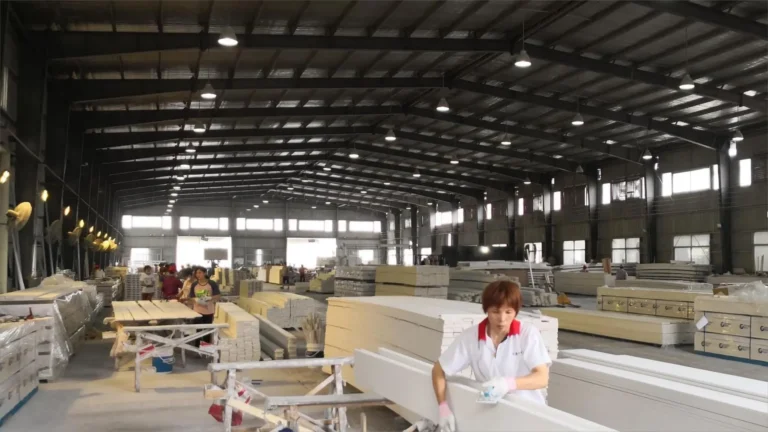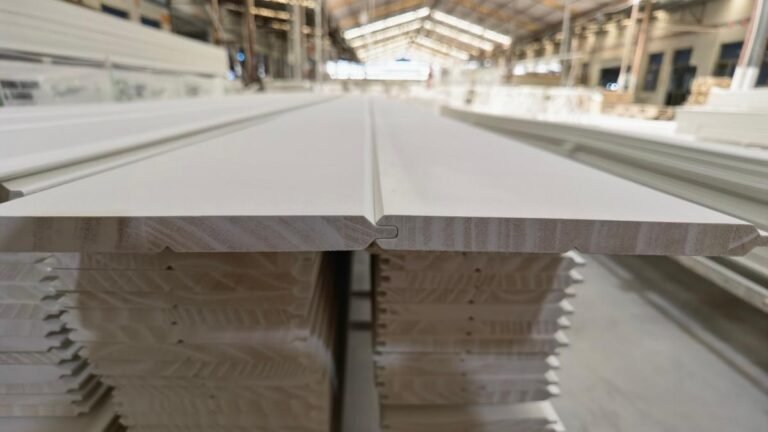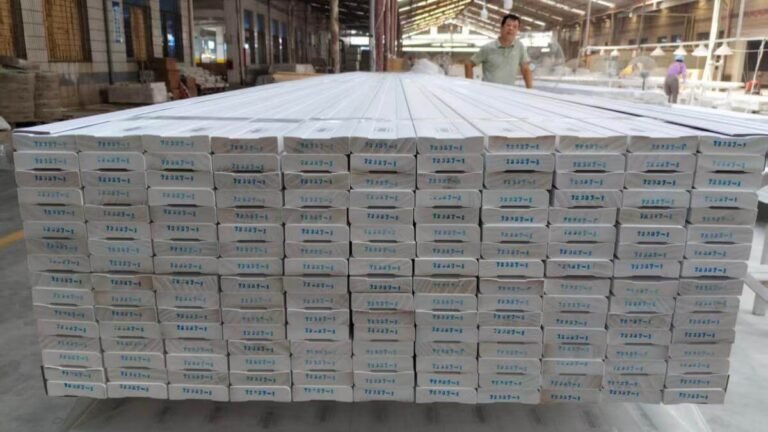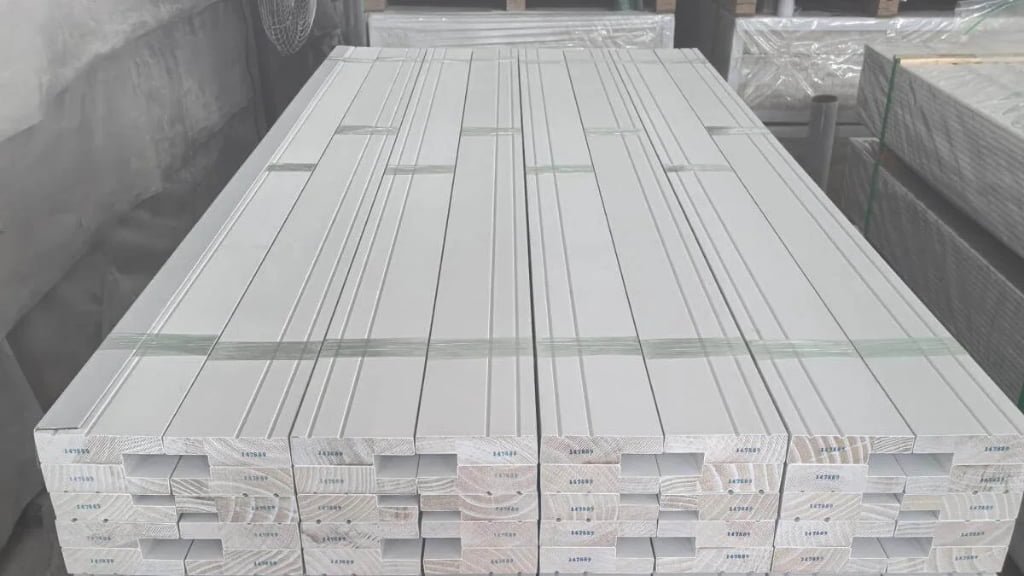
For nearly three decades we've been veneering moulding profiles in-house — hot-pressing, trimming, and finishing all done under one roof rather than outsourced to a third-party veneer shop. That matters for curved profiles specifically, because the failure points on a bent or S-shaped moulding show up at the press, not on the drawing board. If you're specifying a veneered moulding (also spelled molding in the US) for anything with meaningful curvature — an arched door casing, a rounded crown profile, a bullnose transition — the choice between natural wood veneer and engineered veneer isn't a finish preference. It's a structural decision that determines whether your sample comes back clean or comes back with a sand-through defect you have to explain to your customer.
This article lays out where that decision actually breaks, using the thickness tiers and failure data we track on our own production floor.
Why does natural veneer sand through on curved moulding profiles?
On complex curved profiles, 0.3mm natural veneer has a final-inspection sand-through rate of 3–5% — meaning roughly one in twenty to one in thirty pieces gets damaged during the finishing stage, before it ever ships.
The mechanism is straightforward once you see it happen a few times. 0.3mm is the standard commercial-grade veneer thickness, and it works well on flat or gently curved profiles with paint-finish applications. But on a profile with peaks and valleys — the high points of an S-curve, the ridge of a decorative bead — the sanding wheel naturally removes more material at the peak than in the recessed areas. On a flat surface that's a non-issue. On a curved profile, the peak is exactly where the veneer is thinnest to begin with, because it's also where the veneer had to stretch most during pressing. Sand through that peak and the substrate shows through — a defect that isn't fixable, only replaceable.
This is a production-floor observation, not a theoretical one: it's the reason we don't recommend 0.3mm natural veneer as a default for anything beyond simple, low-relief profiles.
Natural veneer vs. engineered veneer: what actually changes on a curve?
The core trade-off is thickness against workability — thicker veneer survives curves and sanding better, but costs more and gets harder to wrap around a tight radius; engineered veneer solves the curve problem by trading natural randomness for manufactured consistency.
| Veneer Type | Thickness | Best Suited For | Main Risk Point |
|---|---|---|---|
| Natural veneer (commercial grade) | 0.3mm | Flat or low-curve profiles, painted finish | Sand-through at profile peaks during final sanding |
| Natural veneer (premium grade) | 0.5–0.6mm | Complex curved outlines, clear/open-grain finish | Higher cost; harder to conform on tight-radius curves |
| Natural veneer (thick-cut) | 0.8–1.0mm | High-end products where a true solid-wood feel is required | Prone to wrinkling at inside corners |
| Engineered veneer | ~0.5mm | Irregular or multi-curve outlines needing consistent color and flexibility | Loses natural, random grain variation |
Engineered veneer isn't a downgrade — it's manufactured specifically to solve the problem natural veneer runs into on complex geometry. It's built with more consistent grain and color across the sheet, and it has more flexibility, which means better conformity to a tight or reversing curve. The trade is that you lose the random, one-of-a-kind grain character that natural wood veneer offers. Neither option is objectively "better" — they're solving for different priorities.

Where's the real cutoff — how much curve is too much for natural veneer?
Profiles with a reverse curve exceeding 45° are where we recommend moving to 0.5mm-plus engineered veneer rather than natural veneer, regardless of grade.
This isn't an arbitrary number — it comes from what actually happens during transport and storage rather than at the press. A 0.3mm natural veneer applied to a complex curved outline can develop slight gap openings at the concave points of the curve when it goes through temperature swings in shipping or warehouse storage. The veneer and the substrate expand and contract at different rates, and on a reverse curve past roughly 45°, that differential stress concentrates exactly at the inside radius — the point with the least material to absorb it.
For anything under that threshold with moderate curvature, premium-grade natural veneer (0.5–0.6mm) is usually workable. Past it, the practical recommendation shifts to engineered veneer, which conforms to the tighter radius without the same open-seam risk. If you're not sure which side of that line your profile drawing falls on, that's exactly the kind of question worth raising during sample development rather than after a production run — it's far cheaper to catch on a drawing than on a shipped batch.
What do you give up either way?
Neither veneer option gives you everything — natural veneer sacrifices batch consistency, engineered veneer sacrifices natural grain character, and no combination of finishing tricks fully closes either gap.
This is the part suppliers don't always say out loud, but it's worth being direct about it because it changes what you order and how you plan inventory:
- Natural veneer's limitation: grain and tone vary from tree to tree, and even within a batch. If you're specifying a large run for a single visible space — a hotel corridor, a matched set of door casings in one room — natural veneer batches won't be perfectly identical to each other. The practical fix isn't a finishing process, it's a purchasing one: confirm you're ordering enough volume from a single batch upfront, rather than reordering later and hoping the new batch matches.
- Engineered veneer's limitation: by design, it trades away the irregular, organic grain variation that makes natural wood look natural. For a brand built around an authentic solid-wood story, that's a real consideration, not just a technical footnote.
Customers need to choose between natural character and consistency — there's no single option that delivers both, and any supplier who tells you otherwise is skipping the part of the conversation that actually matters for your product decision.
One more limitation worth flagging while you're speccing a veneered profile: veneered moulding is not intended for outdoor or field-recut applications without additional edge sealing, since any exposed substrate at a cut edge — whether MDF or finger-jointed solid wood — absorbs moisture the same way an unfinished MDF edge does. If your project involves customers cutting the profile to length on-site, that's a separate conversation worth having before the order is placed, not after.
Frequently Asked Questions
Is engineered veneer as durable as natural wood veneer? On curved and complex profiles, engineered veneer generally performs more predictably — its manufactured flexibility and consistent structure reduce the sand-through and gap-opening risks that natural veneer faces on tight radii. On flat or low-curve profiles, both perform comparably.
Can natural veneer be used on any curved moulding profile? Not reliably past a certain point. Reverse curves beyond roughly 45° are where we start recommending 0.5mm-plus engineered veneer instead, based on the gap-opening risk natural veneer shows at that curvature during shipping and storage temperature changes.
Does engineered veneer look artificial compared to natural wood? It trades away natural wood's random grain variation for consistent color and pattern across the batch — that's a real visual difference, not a flaw to hide. Whether that matters depends on whether your product story leans on natural, one-of-a-kind character or on uniform, predictable appearance.
What veneer thickness should I specify for a tight curve? For moderate curvature, premium-grade natural veneer (0.5–0.6mm) is usually workable. For anything with a reverse curve past 45°, engineered veneer at similar thickness is the more reliable choice. Sending your actual profile drawing is the fastest way to get a specific recommendation rather than guessing from a general rule.
Can veneered moulding be cut and re-finished on-site without extra prep? Any cut edge on veneered moulding exposes the substrate underneath, which needs sealing just like an unfinished MDF edge would. If your project involves site-cut lengths, that's worth flagging during development so the substrate and edge-prep guidance match your installation process.
Choosing between the two for your next development run
If you're developing a curved profile and unsure which veneer grade fits your geometry, the fastest way to de-risk it is to send the profile drawing before committing to a thickness spec. A quick review of the curve radius against the 45° threshold above usually settles the question in a single round of feedback, rather than a sample rejection.
Start a private-label development conversation — send us your curved profile drawing and we'll flag which veneer grade fits before you commit to a production run.
Explore our full veneered moulding product line, or browse more production know-how from our technical FAQ.