Certification lists and factory floor area tell you a manufacturer clears the floor — not whether their process protocols prevent the structural failures and batch inconsistencies that end supply relationships. This guide covers what to verify before placing a first container order with any wood moulding manufacturer, with specific reference to the requirements of door and window companies.
Door and window manufacturers have sourcing requirements that diverge sharply from standard building materials importers. A distributor needs reliable pricing and on-time delivery. A door and window manufacturer needs something harder to verify from a proposal: a production process that prevents failures from appearing 12–24 months after the product ships.
Finger-jointed door frames that develop joint displacement under the cyclic shear load of a solid-core door. Solid wood casing that cups against the wall after a North American heating season. Batch-to-batch color variance that creates warranty claims across an entire production run. These are not conventional quality control failures — they are specification and process failures, often traceable to a single decision upstream in the supply chain.
This guide is structured around that problem: how to evaluate a wood moulding manufacturer not on what the proposal states, but on the process depth beneath it.
What Sourcing Directors Get Wrong When Vetting a Moulding Manufacturer
Certifications have been commoditized. By 2025, most serious exporters serving North American or European door and window companies hold CARB Phase 2 clearance and can produce an ISO 9001 certificate on request. Filtering on these criteria as primary selection variables narrows a longlist to a set of manufacturers that remain largely indistinguishable at the proposal stage.
The specifications that actually differentiate a reliable five-to-fifteen year supply partner rarely appear on a supplier's product page:
- Moisture content target range by destination climate — not a single number, but a calibrated range (8–10% for North American centrally heated interiors; 10–12% for UK and European markets) that must be verified against actual kiln discharge records, not general capability statements
- Adhesive grade for structural door frame production — whether a factory uses PVA or PUR adhesive for finger-jointed carcasses is a structural-performance decision, not a cost variable; PVA-bonded door frames carrying solid-core doors above 35 kg are a documented long-term failure risk
- Batch-level documentation — per-lot moisture content readings, coating batch codes, and dimensional inspection records, retained in a traceable archive that survives the 18 months between shipment and a post-installation claim
- Back-groove specification for wide solid profiles — whether profiles wider than 90mm (3.5 in) are machined with back relief cuts as a standard production step for North American orders, not as an add-on requested by the buyer
A manufacturer who answers each of these questions with specific numbers and documented operating procedures — rather than general quality assurances — is demonstrating the process depth that a long supply cycle requires.
Key takeaway: Certifications mark the entry threshold to any serious export market. Process protocol depth — MC targets, adhesive grade, batch records, back-groove specs — is the actual differentiator for a relationship measured in years, not shipments.
Manufacturing Process: Why Vertical Integration Matters for Batch Consistency
Factory floor area is a capacity measure, not a consistency measure. The variable that directly affects batch-to-batch quality is the degree to which production steps are controlled within a single quality management system, versus subcontracted to third-party facilities operating under separate protocols.
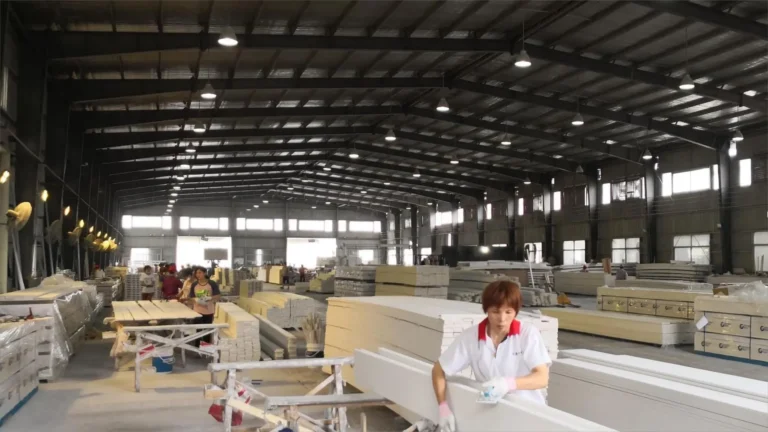
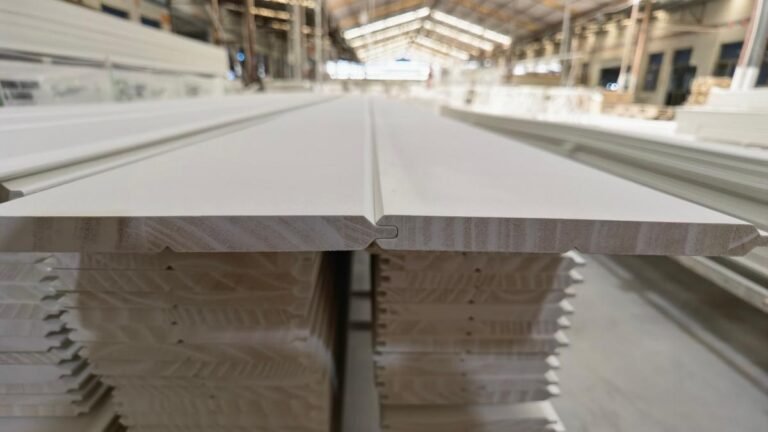
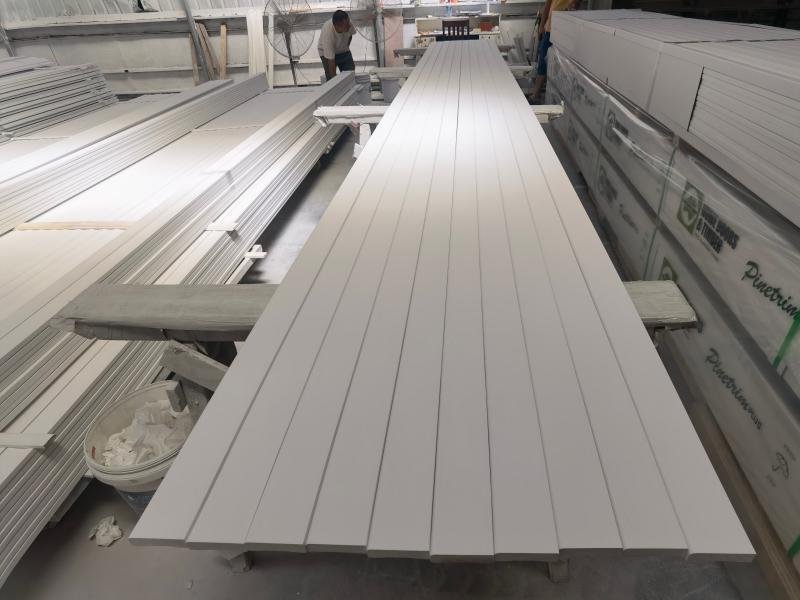
Goodwood Mouldings operates from a 200,000 m² production facility in Xiamen, Fujian, established in 1995. The complete production sequence — raw lumber intake, kiln drying, finger-jointing, veneering, UV and water-based coating, CNC profiling, quality inspection, and packaging — runs in-house. No manufacturing steps are subcontracted.
Why each in-house step matters for a door and window manufacturer specifically:
Kiln drying: Moisture content at kiln discharge is the primary determinant of dimensional stability in service. In-house kiln control allows MC targets to be set per destination market and documented per batch. Solid wood stock above 40mm thickness can exhibit a surface-to-core moisture gradient of 3–5% at discharge — a surface reading that meets specification while the core remains elevated. Processing without a subsequent equalisation period of 1–2 weeks can release internal stress after cutting, causing warping in the finished profile. Monitoring and managing this gradient is only possible when kiln operations are in-house.
Coating: Batch-to-batch color difference (ΔE drift) is most common when coating is subcontracted, because color lot records may be held by the third-party coater rather than archived against individual container shipments. In-house automated spray lines allow color documentation per production lot, referenced against a fixed color standard for the life of the program.
CNC profiling: Custom profile dimensional accuracy depends on tool condition at the point of machining. In-house CNC operations allow mandatory tool-change intervals to be enforced as a production protocol rather than left to operator judgment. At Goodwood, dimensional verification runs at the in-process stage (IPQC), not only at end-of-line inspection.
| Production Step | Goodwood (in-house) | Common subcontract model |
|---|---|---|
| Kiln drying | Yes — per-batch MC records retained | Often pre-dried lumber sourced; no factory-level MC audit available |
| Finger-jointing | Yes — adhesive grade specified per SKU type | Usually in-house, but glue grade selection often not documented per order |
| UV / water-based coating | Yes — automated spray line; color lot archived per batch | Frequently outsourced; color batch records held by the coating subcontractor |
| CNC custom profiling | Yes — IPQC dimensional checks at production stage | Sometimes outsourced for low-volume custom profiles |
| Veneer application | Yes | Often outsourced to specialist facilities |
Specification tip: When evaluating any manufacturer, request the production process flow document and ask specifically which steps are performed in-house and which are subcontracted. Follow by asking where coating color records are archived, and how long they are retained. The answer distinguishes a supplier with traceable batch management from one with only a final inspection stamp.
Certifications That Unlock North American and UK Markets
Treating certification as a binary yes/no check creates a compliance gap that surfaces at the worst possible moment — at customs clearance, at a retailer's vendor audit, or in a product liability claim after installation. The relevant question is not whether a manufacturer has certifications, but whether their specific combination covers the markets where your products are sold.
Goodwood Mouldings holds six active certifications:
| Certification | Primary Market | What It Actually Covers |
|---|---|---|
| CARB Phase 2 | United States — mandatory for composite wood products | Formaldehyde emission from MDF, particleboard, and hardwood plywood; MDF (>8mm) threshold ≤0.11 ppm (ASTM E1333 chamber method) |
| EPA TSCA Title VI | United States — federal level | Aligns with CARB Phase 2; mandatory for US federal import compliance since 2019 |
| FSC Chain of Custody (CoC) | North America, UK, Europe | Raw material traceability to certified sustainable forest sources; required for LEED project credit eligibility |
| CE Marking | European Union; UK (confirm UKCA basis on a product-category level) | Conformity marking for specific architectural wood products under CPR 305/2011 |
| E0 / E1 | Europe, UK, Asia-Pacific | Formaldehyde emission grades: E0 ≤0.065 ppm; E1 ≤0.1 mg/m³ (chamber method, EN 717-1) |
| ISO 9001 | All markets | Quality management system; required by most large EU distributors and home center supply programs for approved-supplier status |
Procurement note: CARB and EPA TSCA Title VI are not duplicate filings — they operate under different regulatory jurisdictions. CARB is a California state regulation; TSCA Title VI extended an equivalent requirement to the US federal level from 2019. Holding both satisfies a California-specific buyer specification and a US federal customs declaration from the same production batch, using the same test documentation.
Market-specific compliance quick reference:
| Market | Minimum Requirement | Recommended for Full Market Access |
|---|---|---|
| United States | CARB Phase 2 / TSCA Title VI | + FSC CoC for green building and government projects |
| Canada | CARB-equivalent (SOR/2016-184) | + FSC CoC |
| United Kingdom | E1 (minimum); CE (product-category dependent) | + FSC CoC + ISO 9001 |
| European Union | CE + E0 or E1 | + FSC CoC + EUDR chain-of-custody traceability |
| Australia | E0-equivalent; ISPM 15 on all wood packaging material | + FSC CoC for specifier and green-rated projects |
Key takeaway: Six certifications covering three regulatory systems (North American, European, international quality management) mean a single production run can be documented for US, UK, and EU destinations without reformulation or re-testing — reducing sourcing administration cost for buyers who supply multiple markets.
Quality Control: Batch Traceability as a Risk Management Tool
A single end-of-line inspection catches visible surface defects and dimensional rejects. It does not produce the batch-level moisture content record that allows a post-installation cupping complaint — arriving eighteen months after delivery — to be traced back to a specific production lot and resolved without broad warranty exposure.
Goodwood's three-stage QC framework:
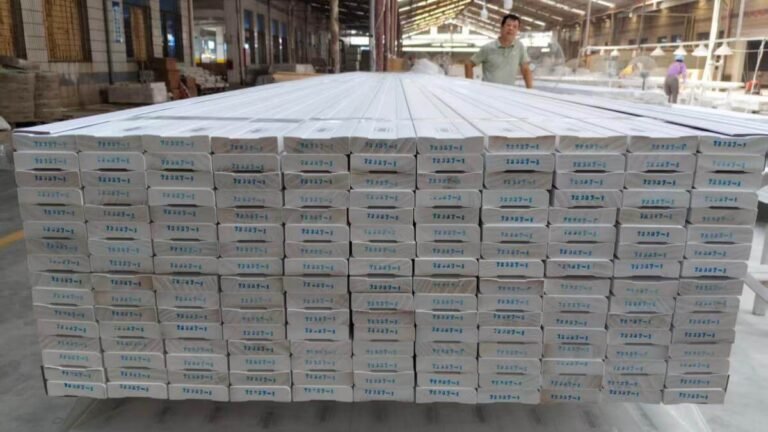
- IQC (Incoming Quality Control): Each incoming lumber batch is measured for moisture content, dimensional accuracy, and species verification before entering the production sequence. Batch number, MC reading, and species data are recorded against the incoming lot.
- IPQC (In-Process Quality Control): Timed-interval sampling at key production stations — CNC profiling (width tolerance ±0.3mm; thickness ±0.2mm), coating application (dry-film thickness per ISO 2409), and finger-joint assembly (gap inspection: premium grade ≤0.3mm; standard grade ≤0.5mm).
- FQC (Final Quality Control): Outgoing shipments inspected to AQL 2.5 sampling (ISO 2859-1). Lots that fall below threshold go to 100% re-inspection before release.
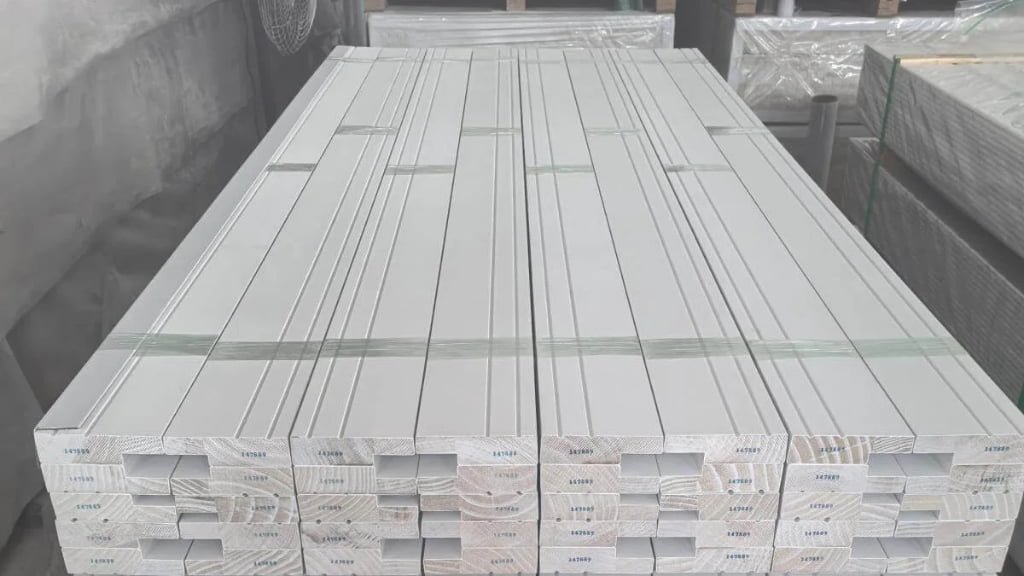
All lot records — kiln-discharge MC, coating batch codes, FQC dimensional reports — are retained per ISO 9001 requirements and available to customers on audit request.
The failure mode that batch records exist to prevent:
A documented failure pattern in North American installations involves solid wood profiles wider than 90mm, exported at moisture content of 11–12%, installed in centrally heated interiors where ambient relative humidity drops below 30% during winter months. The unfinished back face loses moisture faster than the painted front face, generating differential shrinkage and measurable cup-warp within 60–90 days of installation.
Two technical countermeasures address this at the production stage: back-groove (back relief cut) machining on profiles 90mm wide or above as a standard production step for North American orders, and a calibrated export MC of 8–10% (±1%) for North American destinations. Both require documentation at the batch level — without it, tracing a defect report to a specific shipment, and defending against a warranty claim, is impractical.
Trust note: Solid wood profiles 90mm wide or wider, destined for North American centrally heated interiors, require back-groove cuts as a standard production specification — not a premium upgrade. Buyers should confirm this is included in the baseline specification before the first production run, not discovered after a post-installation complaint.
Customization Capabilities: CNC, Profile Development, and Mixed-SKU Logistics
"CNC profiling available" has become a near-universal capability claim among volume exporters. The meaningful specification is the dimensional tolerance the CNC system holds in production — and whether that tolerance is audited at the in-process stage (IPQC) rather than only at final inspection, after any non-conforming product has already been cut to length.
Profile development and production specifications at Goodwood:
- Profile library: 300+ existing cut profiles available for production or adaptation, covering common North American and European standard dimensions
- Custom tooling cycle: New profiles developed from customer-supplied DWG/DXF drawings; typical lead time from approved drawing to first production sample is 7–15 working days
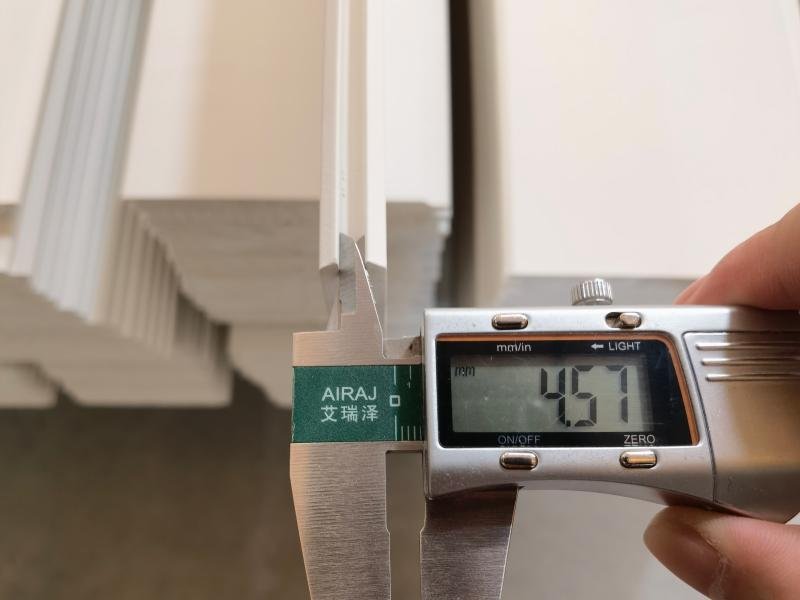
- Dimensional tolerance (solid wood, post-planing): Width ±0.3mm; thickness ±0.2mm; flatness (bow) ≤1mm per 300mm run
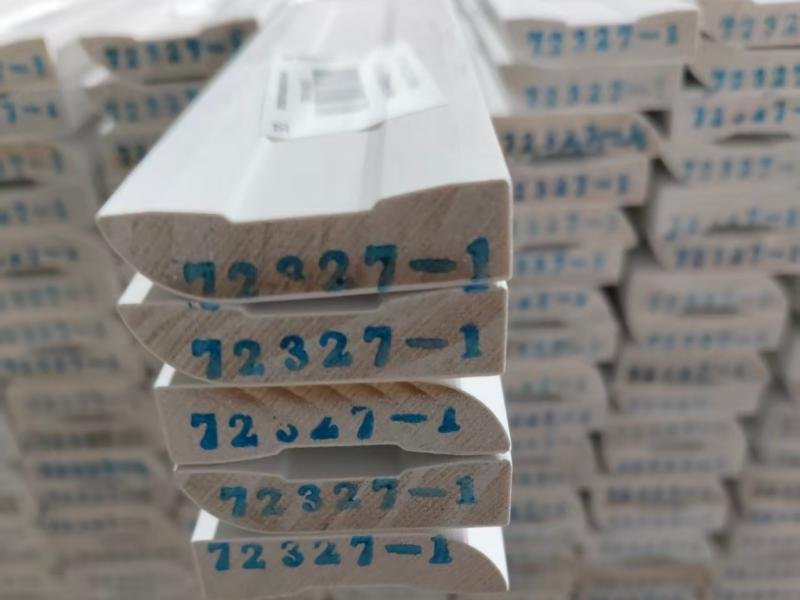
- Container flexibility: 20–60 SKUs per FCL (full container load), mixed across profile types and substrate materials; each SKU palletized separately with individual lot number and MC record for independent inbound verification
Substrate and surface treatment options by application:
| Substrate | Paint-Grade | Stain-Grade | Notes |
|---|---|---|---|
| Solid wood | ✅ | ✅ (select grade) | Species determines stain compatibility; specify stain-grade requirement at ordering stage |
| Finger-jointed | ✅ | ❌ | Joint lines visible under clear or semi-transparent coatings — inherent material limitation |
| MDF | ✅ | ❌ | Smooth, consistent surface suited to opaque paint; not compatible with stain or clear finish |
| Veneered | ✅ | ✅ (natural veneer) | Natural veneer provides wood-grain appearance under clear finish; engineered veneer for paint-grade only |
Specification tip: Finger-jointed moulding (US: molding) is structurally suited to paint-grade applications only. The joint lines become visible under clear, stain, or semi-transparent coatings regardless of joint quality or manufacturing precision. This is an inherent property of the substrate — it applies equally to all manufacturers producing finger-jointed stock and should be reflected in the specification before sampling, not after a finish sample review.
Discontinued and legacy profile reproduction:
For buyers who need a profile reproduced due to a previous supplier's discontinuation, lost tooling, or original manufacturer closure — Goodwood's physical-sample-to-production process runs 3–7 working days from sample receipt to first production sample. A DWG file is not required; the physical sample is the specification input. Over 300 profiles have been reproduced through this process across the production history of the facility.
Key takeaway: A ±0.3mm width tolerance (vs. a common industry range of ±0.5mm) directly determines the tightness of fit between a door casing profile and the door frame rabbet. Request the actual tolerance spec in writing — not a general quality assurance statement — before approving a sample.
When Goodwood Is Not the Right Fit
A manufacturer that presents itself as the correct choice for every application is prioritising proposal success over accuracy. The scenarios below represent genuine mismatches between Goodwood's supply model and a buyer's requirement — identifying them early saves time on both sides of the sourcing process.
| Buyer Requirement | Fit Assessment | Recommended Alternative |
|---|---|---|
| Order volume below one full container (FCL) | Not a fit. Minimum order quantity is one 20ft or 40ft FCL. Sub-container quantities carry a cost structure that makes FCL supply unworkable at this volume. | Local building materials distributor with held spot inventory |
| Delivery required within 14–21 days of order placement | Not a fit. Production lead time plus ocean freight transit (12–22 days to North American ports; 18–25 days to UK) means total order-to-delivery floors at approximately 6–10 weeks for standard in-production profiles. | Regional wholesale supplier with local warehouse stock |
| Stain-grade or clear-finish finger-jointed profiles | Not a fit for stain-grade application. All finger-jointed stock — regardless of supplier or joint quality — shows joint lines under transparent or semi-transparent coatings. | Solid wood select-grade profiles (available as a separate SKU from Goodwood for applications where stain-grade is specified) |
| B2C or individual homeowner purchase | Not a fit. Supply is exclusively to registered B2B trade buyers with minimum FCL order volumes. | Local home improvement retailer or builders' merchant |
| Single arbitrary sample with no production intent | Limited fit. Sample requests are managed through a structured program with a 3–7 working day turnaround; ad hoc single-profile requests outside this process are not supported. | Contact via the formal sample program (details below) |
Trust note: The 6–10 week lead time above is the floor for standard profiles already in production. For custom profiles requiring new tooling, add the tooling cycle (typically 7–15 working days from approved drawing). Factor both figures into your supply planning before requesting a quote.
How to Proceed: Samples, RFQ, and First Shipment
Sample requests — including profile reproduction from a physical sample supplied by the buyer — are handled through Goodwood's sample program. Standard turnaround is 3–7 working days from receipt of the specification or physical sample. Samples are finished production pieces in the specified profile, substrate, and surface treatment, not promotional demonstration pieces.
For a production RFQ, the information required for an accurate first quote:
- Profile specification — DWG/DXF file, or a physical sample for reproduction profiles; include cross-section dimensions and any back-groove or relief cut requirements
- Substrate and grade — Solid wood (specify species where applicable), finger-jointed, MDF (density class: standard or high-density), or veneered; state whether the application is paint-grade or stain-grade
- Surface treatment — Primed white, UV-primed, unfinished, or custom color (provide RAL or NCS reference number for custom colors)
- Target moisture content — North American destination: 8–10%; UK/European destination: 10–12%; specify the destination climate
- Lengths and per-SKU quantities — Include total container count (20ft or 40ft FCL) and any mixed-SKU loading requirements
- Certification requirements — Specify which certifications apply to your destination market: CARB, FSC, E0/E1, CE
Submit an RFQ → | Request a Sample →
Frequently Asked Questions
What is the minimum order quantity for Goodwood Mouldings? The minimum order is one full container load (FCL) — either a 20ft or 40ft standard container. Mixed-SKU loading up to 60 profiles per container is supported, with each SKU palletized and labeled separately. Sub-container (LCL) orders are not available through Goodwood's direct B2B supply channel.
Does Goodwood hold CARB Phase 2 certification for MDF moulding products? Yes. Goodwood holds CARB Phase 2 certification covering composite wood products including MDF mouldings. The applicable formaldehyde emission threshold is ≤0.11 ppm for MDF above 8mm thickness, tested by the ASTM E1333 chamber method under California Code of Regulations, Title 17. The same certification satisfies US federal EPA TSCA Title VI requirements, which have been aligned with CARB Phase 2 since their full implementation in 2019.
What dimensional tolerances do Goodwood's CNC profiles hold in production? For solid wood profiles after planing, the production tolerance is ±0.3mm on width and ±0.2mm on thickness. Flatness (bow) is specified at ≤1mm per 300mm of run length. These specifications are verified at the IPQC (in-process) inspection stage and confirmed at FQC (final inspection) before shipment release — not only at end-of-line sampling.
Can Goodwood reproduce a discontinued profile if we have only a physical sample and no drawing? Yes. Profile reproduction from a physical sample is a supported service. The standard turnaround from physical sample receipt to first production sample is 3–7 working days. A DWG or DXF file is not required — the physical sample serves as the dimensional specification input. This service has been used to reproduce over 300 profiles, including discontinued products from manufacturers no longer in operation.
Is finger-jointed moulding suitable for structural door frame applications with heavy solid-core doors? Finger-jointed moulding bonded with PVA adhesive is not recommended for door frames carrying solid-core doors above approximately 35 kg. PVA-bonded joints under cyclic shear load — the repeated opening and closing of a heavy door — can exhibit creep displacement within 12–24 months of installation. For structural door frame applications at these door weights, PUR (polyurethane) adhesive-bonded finger-jointed stock is the appropriate specification. Goodwood produces both PVA and PUR adhesive variants; the correct grade should be specified at the ordering stage, not selected based on cost alone.