If you've started sourcing wood mouldings for a project — whether you're a distributor filling out a warehouse line, a door manufacturer looking for matching casing, or a millwork company sourcing for a build — you've probably noticed that "wood moulding" isn't really one product. It's a category that covers several very different materials, each with its own strengths, limitations, and best-fit applications. This guide draws on production experience from Goodwood Mouldings, a manufacturer that has operated a 200,000 m² production facility in Xiamen, China for nearly three decades, to walk through what actually separates these categories.
Getting this right before you send a request for quote (RFQ) saves time on both sides. A supplier can give you a faster, more accurate quote when you already know whether you're asking about solid wood, finger-jointed, MDF, or veneered moulding — and what each one can and can't do.
"Wood Moulding," "Trim," or "Profile"? Getting the Terminology Right First
Before getting into categories, it helps to know that the terminology itself varies by market. In Canada, "moulding" (British/Commonwealth spelling) is the standard term, while US-based suppliers and buyers often use "molding" and "trim" interchangeably. "Profile" is a related but distinct term — it refers specifically to the cross-sectional shape of the piece, not the product as a whole. You'll see it most often on technical drawings and in supplier cross-section catalogs.
None of this changes what you're buying, but using the right term in an RFQ signals to a supplier that you know what you're asking for — and it reduces back-and-forth clarification before a quote can even start.
Four Core Categories — What They're Actually Made Of
Solid Wood Moulding
Milled from a single piece of solid timber, with no joints or seams. It offers natural grain and takes stain well, which makes it the default choice when a project calls for a visible wood finish rather than paint.
The trade-off is stability. Solid wood expands and contracts with humidity changes — it's a physical property of the material, not a manufacturing defect. In wider profiles, especially those installed in heated interiors during winter, that movement can be visible enough to matter on a finished project.
In production, we've found that moisture content passing kiln-drying targets doesn't automatically mean a piece is ready to ship. Thicker solid wood stock can dry unevenly — the outer layer reaches target moisture faster than the core, leaving a gap of a few percentage points between the two. Skip the resting period before further processing, and that internal stress can show up later as bowing or cracking after the product has already reached the job site. It's a detail that's easy to miss if drying is judged by the surface reading alone.
Finger-Jointed Moulding
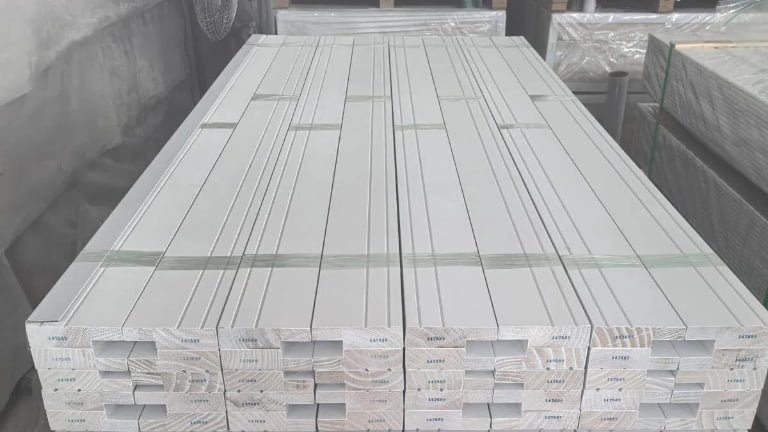
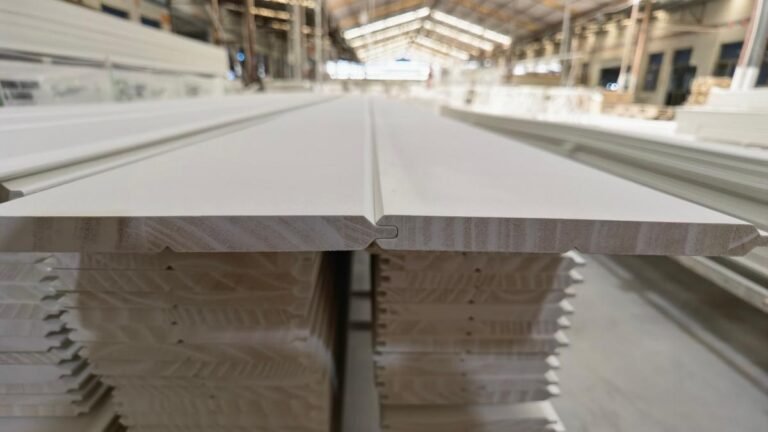
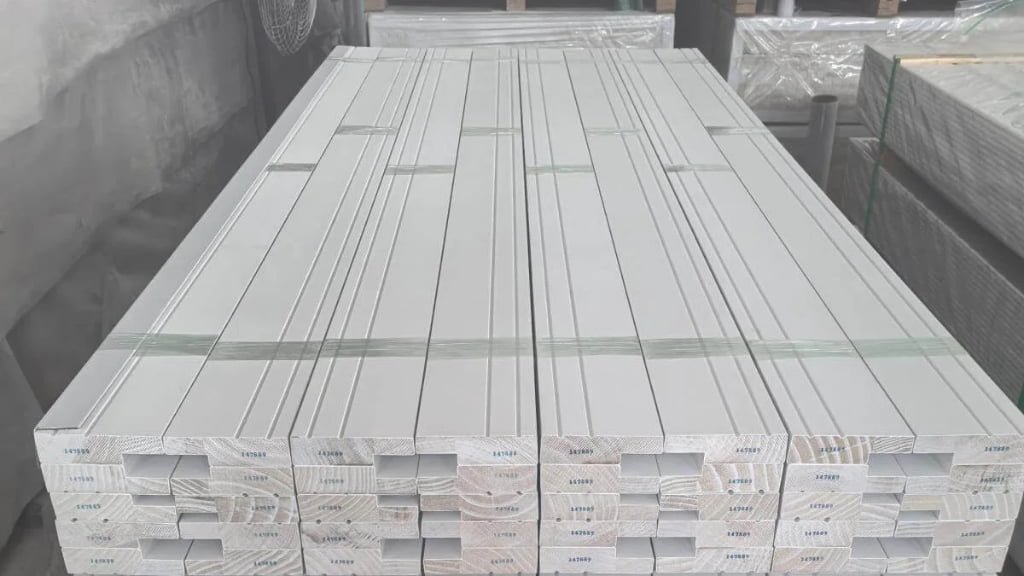
Made by joining shorter wood segments end-to-end using a finger-jointing process, then milling the combined length into the final profile. It's the dominant format in North American paint-grade supply because it uses timber more efficiently and reduces warping compared to long single-piece solid wood.
The one thing to know going in: finger-jointed moulding is not suitable for stain-grade or clear-finish applications. The joints remain visible under transparent coatings no matter how precisely they're cut — this is a structural characteristic of the product, not something specific to one supplier's process.
MDF Moulding
Built from medium-density fiberboard, MDF moulding gives an extremely flat, consistent surface — ideal for paint-grade work where color and finish uniformity matter more than natural grain. It's a common choice for retail chains and commercial projects that need matching profiles across many units.
MDF's limitation is moisture. It should not be specified for exterior use or persistently damp interior environments — bathrooms with poor ventilation, for example. Edges are also more prone to chipping during handling than solid wood, so installers typically need a bit more care during transport and fitting.
Veneered Moulding
A thin layer of real wood veneer applied over an MDF or finger-jointed core, giving the visual appearance of solid wood at a lower material cost. It's a practical middle ground when a project wants a natural wood look but doesn't need — or can't justify the cost of — solid timber throughout.
Because veneer comes from natural wood, grain and tone can vary slightly between batches. For projects where a large, continuous run needs to look uniform, it's worth confirming with your supplier that enough matching-batch stock is available before ordering.
Quick Comparison — Which Category Fits Which Project
| Solid Wood | Finger-Jointed | MDF | Veneered | |
|---|---|---|---|---|
| Dimensional stability | Lower (moves with humidity) | Moderate | High | Moderate–High |
| Typical finish | Stain or paint | Paint only | Paint only | Stain or clear coat |
| Relative cost | Highest | Moderate | Lowest | Moderate–High |
| Best suited for | Feature areas, stain-grade trim | High-volume paint-grade runs | Uniform commercial/retail runs | Natural-look projects on a budget |
| Not recommended for | Ultra-tight budget runs | Any clear/stain finish | Exterior or high-moisture areas | Extremely large runs needing perfect grain match |
Questions to Ask Yourself Before You Request a Quote
A few quick self-checks can narrow down which category to specify in your RFQ:
- Will this be painted or stained? If stained, solid wood or veneered moulding are your options — finger-jointed is off the table.
- Will it be installed anywhere with sustained moisture exposure? If yes, MDF and veneered products need to be ruled out; this generally points toward solid wood with appropriate finishing.
- Does the project require tight batch-to-batch color consistency? MDF handles this most predictably, since it doesn't carry natural grain variation.
- How large is the order, and how flexible is your budget? Larger paint-grade runs typically favor finger-jointed or MDF for cost efficiency; smaller, higher-end runs can absorb solid wood or veneer.
Answering these before you contact a supplier means your RFQ can specify a category from the start, rather than going back and forth on basics.
What Comes Next — Evaluating the Supplier Behind the Product
Knowing which category fits your project is the first step. The second — and often more consequential — step is evaluating whether a given supplier can actually deliver that category consistently, on time, and with the documentation your business needs.
Goodwood Mouldings is a manufacturer that has specialized in wood mouldings, architectural decorative materials, and engineered profiles for nearly three decades, operating a 200,000 m² production facility in Xiamen, China, and serving distributors, door and window manufacturers, importers, and project clients across North America, Europe, and Australia. Because all four categories above — solid wood, finger-jointed, MDF, and veneered — are produced in-house, buyers working across multiple product lines can consolidate sourcing with a single supplier rather than managing separate vendors for each material type.
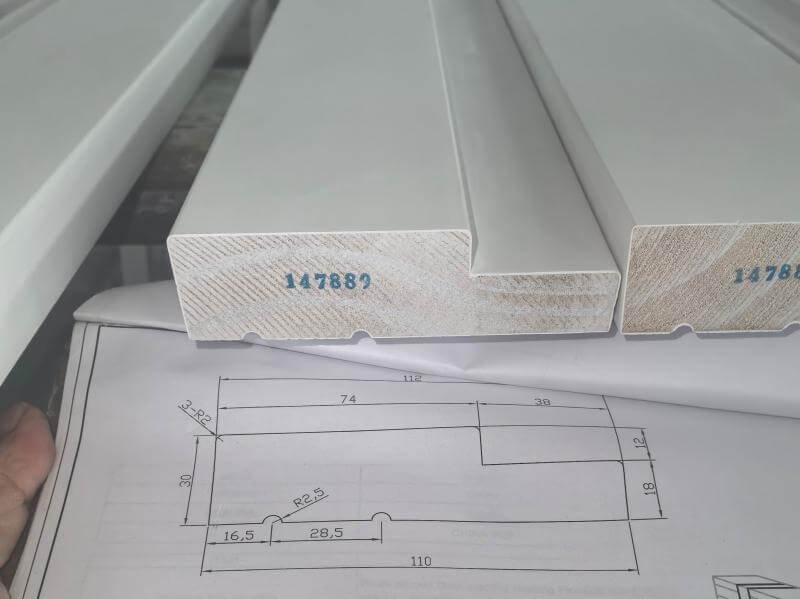
If you're ready to move from category to specifics, the next step is usually a closer look at how to evaluate a supplier's capacity, documentation, and consistency — which we cover in a separate guide. If your project needs a profile outside our standard range, that's also worth raising early: as a custom wood moulding manufacturer, we can develop new cross-sections from a drawing rather than limiting you to an existing catalog.
FAQ
What's the difference between MDF moulding and solid wood moulding? MDF moulding is made from engineered fiberboard and offers a flatter, more consistent surface ideal for paint-grade finishes, while solid wood moulding is milled from a single piece of timber and shows natural grain, making it better suited to stained or clear-finish applications. MDF is not recommended for exterior or high-moisture use; solid wood is more dimensionally responsive to humidity changes.
Can finger-jointed moulding be stained instead of painted? No. The joints between wood segments remain visible under stain or clear finishes regardless of manufacturing precision. Finger-jointed moulding is designed for paint-grade applications only.
Is veneered moulding as durable as solid wood? Veneered moulding performs well for its intended use — giving a natural wood appearance at a lower cost — but it isn't a direct substitute for solid wood in every scenario. Because the veneer core is typically MDF or finger-jointed wood, the same moisture-exposure limitations apply, and very large runs may need extra attention to batch matching for consistent grain appearance.
Send us your project drawing for a feasibility check — we can help confirm which category and specification best fits your build.